“The future’s another country, man… And I still ain’t got a passport”*…
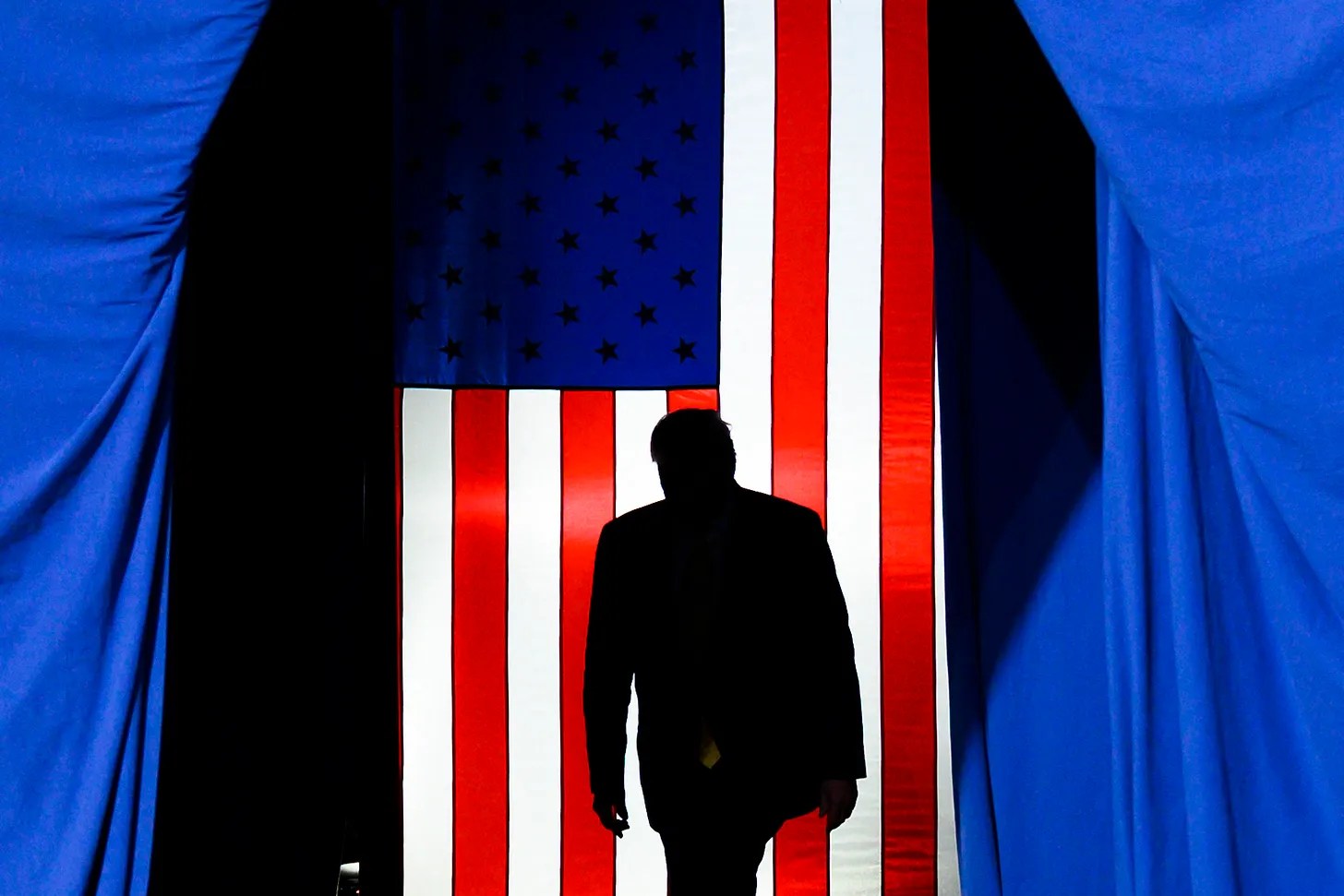
Hamilton Nolan on seeing things for what they are, not what they used to be…
Born into a chaotic world, all of us develop a frame of reference to make everything intelligible. Consciously or not, we all have a narrative about reality that we overlay on events, placing them into a context in our own minds, allowing us to understand why things happened and what is likely to happen next. In the same way that our brains automatically filter out much incoming stimulus in order to provide us with a breadth of sensation that we can handle, our belief systems allow us to turn life’s waterfall of events into a story that we can read, and participate in.
Once we have developed this frame, this mental machine that inhales life and exhales explanations, it is tempting to allow it to run unimpeded. We can anchor ourselves to it and stop wondering why things happen. Religion is the classic example of this, but it applies to all realms of thinking. The problem with this approach is that it ignores the fact that these frames we generate are only approximate—they are the best we can do at any given time given the facts at hand. If we are actually concerned with keeping them as close to truth as possible, we must constantly dust them off and rework them in light of the unfolding of reality. This is what learning is. It takes work. It is tempting to check out from it, after we have enough to get by. Once we have an explainer machine that seems to work, it is easy to stick with it. The passing of time, the ceaseless interaction of people and things and ideas that produce events in the world, will render our frames anachronistic. Still, it is human nature to kind of relax into them, at a certain point, like an elderly person who sticks with their 20 year-old computer because they know how it works, turning off the software updates, satisfied with what they have.
This is a luxury that people in certain fields cannot afford. Science? Can’t stop updating. Medicine? Of course you must stay current. Literature? Technology? Academia? You must always do the painful work of tearing apart and rebuilding your knowledge and beliefs because failing to do so means that will not be good at your job. Politics is the same. Effective political policies and strategies are direct responses to the true condition of the world. Delusion does not pay. If the world changes and our political leaders don’t, it is the political leaders and not the world that will be left behind. The people who suffer for this failure are not usually the leaders, but the citizens who find that the leaders seem to have gone blind.
Things have changed in America. There are deep undercurrents that have been exerting pressure from below—the relentless evolution of global capitalism, the growth of inequality, new forms of technology jumbling the world of information—and then there are things that have changed rapidly, closer to the surface. It was possible to use a certain frame of reference that worked pretty well in the American political system for the past 40 years or so. But now that frame is out of date. It is worse than useless. It is misleading. It is detrimental, because the answers it spits out, the explanations it gives, the strategies it recommends for specific situations, are all based upon old data and old wisdom that no longer works. The frame of reference that guides many of the people who, unfortunately, dominate the Democratic Party in Washington is like a flood map that was drawn up before climate change. They keep using these same old formulas that worked back then, ignoring the rising water as it creeps up to their necks.
Reagan and Bush and Clinton and Bush Jr. and Obama all to varying extents did awful things and all to varying extents are responsible for the progression of the state of our politics to this point, but they also all believed themselves to be constrained by a set of guidelines, norms, and political realities that no longer exist. Even their most immoral policies were shaped to maneuver through public opinion and economic demands and historic traditions and laws that have now, effectively, disappeared. The playbook that political veterans used to operate in that old world is a set of directions to a house party that is already over. If you show up there you will only find an empty house. The action is elsewhere now. Chuck Schumer continues to pull up in front of that empty house each morning, blinking vacantly, knocking on the door with a bottle of wine in his hand, wondering what is taking so long.
Here are a few notable ways in which many (not all) of our political and media and business and intellectual leaders have failed to update their priors for current times: The federal government is now controlled by a political party that is nakedly, not bashfully, racist, and hopes to eradicate the past century’s worth of racial progress; economic policy is being dictated, stupidly, by a small group of zealots who do not understand economics; the primary concern of the president now is vengeance, and he is going to use the tools at his disposal to enact vengeance upon his endless list of enemies in a way that could surpass McCarthyism; “civil liberties” mean nothing to those who control the federal government now, and will likely provide little protection from that vengeance in the real world; the law, and the power of the courts to enforce laws that constrict the behavior of the federal government, is very much in question, and it is distinctly possible that within the next year or two the law is exposed as toothless in the face of the president’s will, and therefore the law should not be relied on as the primary guard rail of our democracy now; voter suppression is about to reach extremes not seen in generations, and outright election theft based on shoddy racist claims of voter fraud is extremely likely in upcoming elections at all levels; the US government is going to lose its status as a reliable source of information—economic statistics, scientific data, and more—as official information is manipulated for partisan gain in unprecedented ways, a development that will be devastating for almost all fields of knowledge, and for the economy; the federal government is being run by people who want to eradicate the government’s functions, except to the extent that those functions can be used to crack down on foreign and domestic enemies; many people are going to be jailed and deported and potentially killed unjustly in the very near future, by the president and his loyalists; institutions that imagine themselves to be proud, ethical, important parts of the fabric of America are going to cower in fear and abdicate their responsibilities in ways that their own leaders would scoff at right now. We are not living in “The West Wing.” We are living in “Goodfellas.” It does not have a happy ending…
… Extreme things—things that sit completely outside of the mental framework that too many of our political leaders are still using to govern their decisions—are happening now. And they are going to happen more. And they are going to get more extreme. This does not mean that we are in a hopeless situation. It does, however, mean that we must adjust our interpretation of the world, or be left behind. We must see things not for what we wish they were, or for what they used to be, but for what they are. There is no way to see beyond the curve when you’re looking towards the past…
Facing the future: “Seeing Things For What They Are,” from @hamiltonnolan.bsky.social.
Cases in point: “Trump and the Rise of the Multiracial Right” and “Tariffs on goods may be a prelude to tariffs on money.”
* Zadie Smith, On Beauty
###
As we reframe, we might recall that, while today s of course St. Patrick’s Day, in Suffolk County, Massachusetts (which includes the cities of Boston, Chelsea Revere, and the town of Winthrop), and also by the public schools in Somerville, Massachusetts, residents are celebrating Evacuation Day, commemorating the evacuation of British forces from the city of Boston following the siege of Boston, early in the American Revolutionary War. Schools and government offices are closed.

You must be logged in to post a comment.