“One must still have chaos in oneself to be able to give birth to a dancing star”*…
Long-time readers will know of your correspondent’s fascination with– and affection for– outsider art. We’ve looked at Henry Darger, Ron Gittins, Grandma Moses, and others– so many of whom have been fueled by fervent faith. From Jeff MacGregor, another wonderful example…
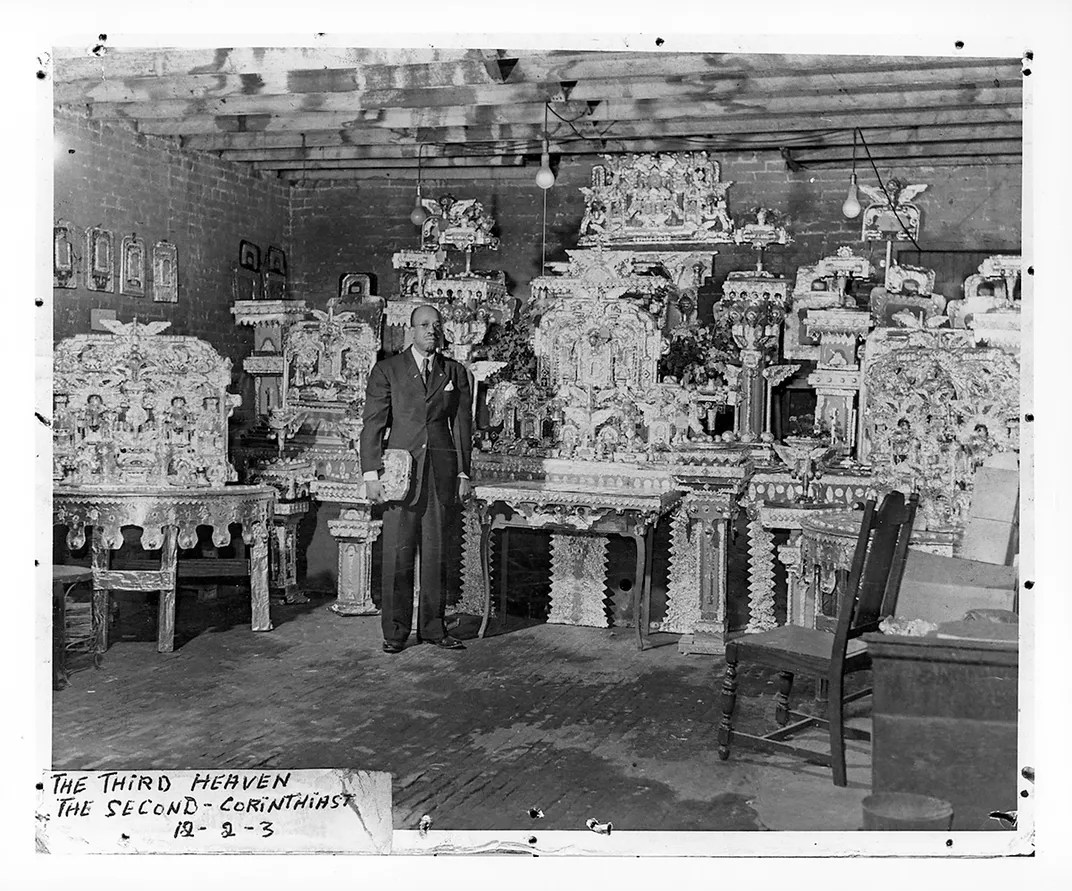
For some 14 years he labored in solitude. Lovingly. Obsessively. Every night after work, in a rented garage on 7th Street NW in Washington, D.C., James Hampton, a World War II veteran and janitor for the General Services Administration with no artistic training, methodically built what he came to call The Throne of the Third Heaven of the Nations’ Millennium General Assembly. Hampton prepared the throne to receive Jesus, flanked by a dozen angels, at the time of the Second Coming.
Born in 1909 to a South Carolina preacher, Hampton, who may have lived with schizophrenia, had his first religious vision at the age of 22—a visitation from the patriarch Moses. He later said Adam and the Virgin Mary had come to him as well. Why he began the Throne in 1950, no one can say. Passion. Devotion. Divine inspiration. But it came to comprise a handmade masterpiece of 180 or so separate components, each crafted from found and scavenged parts. Hampton embellished discarded furniture and light bulbs, tin cans and jelly jars with gold and silver foils and wrapping paper—materials reflecting light and inspiring something like awe at the prospect of an apocalyptic end to this world and the peace and glory to come in the next. Leslie Umberger, a curator at the Smithsonian American Art Museum, describes the part of the sculpture on display as the “central section of a spiritually driven, pulpit-style array” that Hampton created “as a sacred space for sharing his faith.” The “third heaven” is a reference to God’s home, an exalted heaven-within-a-heaven; the Throne, Hampton is reported to have said, “is my life. I’ll finish it before I die.”
Hampton’s materials were an inventory of junked 1950s office supplies: inks and desk blotters, construction paper and sheets of transparent plastic. The chairs and altars and offering tables are made of what he carted home from used furniture sellers, often cut in two. Each half of the assembly is beautifully symmetrical with the other. It is a miracle of craft and art and carpentry, of architecture and engineering, ingenuity and loneliness and holy madness. With a million featherlight hammer taps, Hampton built batches of trim molding and sawtooth decoration. Wings upon wings upon wings. Above the throne, Hampton placed these words of reassurance from Revelation 1:17: “Fear not.”
The Throne’s story has since hardened into legend. Hampton died of cancer at a Veterans’ Administration hospital in 1964. The work was unfinished. But then his landlord, Myer Wertlieb, came to the garage to collect the overdue rent, not knowing Hampton had died. Instead, he found the Throne. For months, Wertlieb searched without much success to find someone, anyone, who might want it. Then Harry Lowe got involved.
“It was like opening Tut’s tomb,” Lowe, head of exhibitions and design at what was then the National Collection of Fine Arts, told the Washington Post about entering that garage for the first time. Lowe paid the landlord Hampton’s back rent and arranged the purchase of the entire assembly for the museum. A selection from the center section was first exhibited in 1971. The illustrious art critic Robert Hughes wrote in Time magazine that the Throne “may well be the finest work of visionary religious art produced by an American.” Just as often, though, critics marginalized it as “outsider” art…
How deep faith created one of the loveliest—and most curious—sacred objects in the Smithsonian collections: “In His Garage, an Untrained Artist Created a Work of Sublime Divinity,” from @Jeff__MacGregor in @SmithsonianMag… where you’ll find more of the story and more wonderful photos.
* Friedrich Nietzsche
###
As we appreciate art, we might recall that it was on this date in 1866 that Charles Elmer Hires created a faith-inspired addition to the culinary (well, gustatory) arts: he formulated his eponymous “root beer.” Hires was inspired by root tea, but thought that “beer” would be a more attractive name to “the working class”– for whom Hires, a supporter of temperance, saw it as an alternative to alcohol. While he failed in weaning the working man from his suds, his concoction was a hit that helped establish the “soft drink” category and attracted numerous competitors.

You must be logged in to post a comment.