Posts Tagged ‘Number theory’
“A mathematician is a device for turning coffee into theorems”…
In 1937, Lother Collatz proposed that, when starting with any natural number (positive integer) n, then either dividing it by 2 if n is even, or multiplying n by 3 and adding 1 if n is odd, then continuing this process indefinitely, one will always reach the number 1.
The proposition is pretty broadly known as “The Collatz conjecture”; but as it commanded the energies of a number of other mathematicians, it is also sometimes called “the Ulam conjecture” (after Stanislaw Ulam), “Kakutani’s problem” (after Shizuo Kakutani), “the Thwaites conjecture” (after Sir Bryan Thwaites), “Hasse’s algorithm” (after Helmut Hasse), or “the Syracuse problem.” More generically, it’s often just called the “3n+1 conjecture”… and the sequence that it generates, “the wondrous numbers.”
But as wondrous as the sequence may be, it is no pushover to prove. Indeed, legendary (and legendarily “homeless”) mathematician Paul Erdos– the source of this post’s title quotation– posted a $500 prize for a proof… an offer he never had to make good. Still, most mathematicians who have played with the problem believe the conjecture to be true,as both experimental evidence and heuristic arguments support it.
It is in any case, fascinating– and beautiful. London-based designer Jason Davies has created a visualization of the Wondrous Numbers, an animation that runs the Collatz logic in reverse— starting with 1 and “growing” a tree of natural numbers:
 click here to watch this grow from a single digit
As we remark that there’s a fundamental propriety to everything in the world ultimately coming back to one, we might recall that it was on this date in 1940, at approximately 11:00 am, that the first Tacoma Narrows suspension bridge collapsed due to wind-induced vibrations. Situated on the Tacoma Narrows in Puget Sound, near the city of Tacoma, Washington, the bridge had only been open for traffic a few months. For those who missed it in high school physics:
What you do know can hurt you…
From the ever-entertaining xkcd, a behavioral analog to the Monty Hall Problem (and the variation considered here a couple of weeks ago)…

As we reconsider the odds, we might recall that it was on this date in 1777 that Swiss mathematician, physicist, and astronomer Johann Heinrich Lambert died in Berlin. Lambert, who was only 49 when he passed, made a number of contributions to scientific knowledge; but he is probably best remembered for the first proof (in 1768) that pi is irrational (that’s to say, can’t be expressed as the quotient of two integers).

I was expecting… well, a deep, booming voice…
Readers will recall the effort at CERN’s Large Hadron Collider to discover the Higg’s Boson— “The God Particle.” The Telegraph reports that while the search for the sub-atomic fugitive continues, scientists have determined that, when it is created at the Swiss supercollider– if it is created— ” it will sound like several coins clattering around the bowl of a wine glass.”

Scientists used information from computer models to calculate what the creation of the particle will sound like, a process called “sonification”.
LHC Sound, a group of scientists, musicians and artists in London, has used data on the particles and matched it to qualities such as pitch and volume to determine how the collision will sound.
Dr Lily Asquith, who models data for the LHC and has contributed to the sound project, wrote on her blog: “Sound seems the perfect tool with which to represent the complexity of the data.
“Our ears are superb at locating the source and location of sounds relative to one another … We also have an incredible ability to notice slight changes in pitch or tempo over time and to recognise patterns in sound after hearing them just once.”
Read the full report here.
As we reinterpret the soundtracks of our lives, we might recall that it was on this date in 1742, in a letter to Leonhard Euler, that Christian Goldbach outlined his famous proposition, now know as “Goldbach’s Conjecture”:
Every even natural number greater than 2 is equal to the sum of two prime numbers.
It has been checked by computer for vast numbers– up to at least 4 x 10¹⁴– but remains unproved.
 Goldbach’s letter to Euler (source, and larger view)
Your number is up…

From the admirable Tonya Khovanova, everything one could want to know about a number– any number: Number Gossip.
Consider the results returned for your correspondent’s favorite pair of digits, 27:
– 27 is the only number which is thrice the sum of its digits
– 27 is the first composite number not divisible by any of its digits
– 27 is the largest number that is the sum of the digits of its cube
– 27 is the only 2-digit number in which the sum of digits is equal to the sum of prime factors (27 = 3 * 3 * 3 and 2 + 7 = 3 + 3 + 3 = 9)
– A 10,000-day-old person is 27 years old
– 27 is the smallest cube out of two known with only prime digits (the other cube is 3375)
– A web page about 27: <http://27.chrismore.com/>The Mystery of the number 27
– 27 is the smallest evil cube
As Tonya suggests, “Enter a number and I’ll tell you everything you wanted to know about it but were afraid to ask.”
As we worry about running out of fingers and toes, we might recall that it was on this date in 1912 that The Girl Scouts were born in the U.S., as Juliette “Daisy” Gordon Low (who’d met and been deeply influenced by Scouting founder Robert Baden-Powell in London) organized the first Girl Scout troop meeting of 18 girls in Savannah, Georgia. The annual sale of cookies as a fund-raiser began in 1917.
 Ms. Low, flanked by two Scouts
284 is an amicable* number…
 source: Cornell
… and 192 is the smallest number with 14 divisors… and 153 is a narcissistic number… and 38 is the last Roman numeral when written lexicographically… and…
Thanks to Dr. Erich Friedman, we can find out “What’s Special About This Number?”
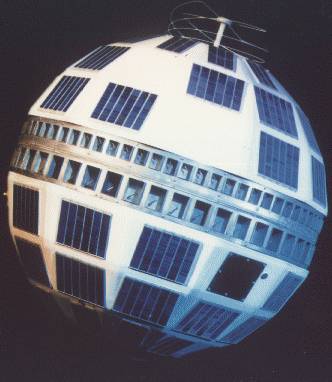
As we alternate between the ordinal and the cardinal, we might recall that it was on this date in 1962 that the world got a little smaller, as the Telstar I satellite relayed the first live trans-Atlantic television signal.
![Reblog this post [with Zemanta]](https://i0.wp.com/img.zemanta.com/reblog_e.png?w=700)
You must be logged in to post a comment.