Posts Tagged ‘Knight Rider’
“I know a lot about cars, man. I can look at any car’s headlights and tell you exactly which way it’s coming”*…

… too often, it’s coming for us…
Over a 15-year period, 6,253 cars crashed into 7-Eleven storefronts in the U.S. – an average of 1.14 per day.
– Source
Of course, retail rampages are the least of our automotive worries. In the last several years– after decades of decline, and unlike other developed countries– vehicle deaths in the U.S. begin to grow (gift article).

While there are a number of factors at work, an extraordinary piece in The Economist homes in one of the most salient: Americans love big cars, but heavy vehicles kill more people than they save…
For all the safety features available in cars today to help them avoid crashes, the laws of physics are cruel. When two vehicles collide, it is usually the heavier one that prevails. This advantage has changed little over time. Thirty years ago when a passenger car crashed with a pickup truck or sport-utility vehicle (SUV), the driver of the car was roughly four times as likely to die; today this driver dies around three times as often. Critics say this is too high a price to pay for roomier interiors and more powerful engines. Carmakers insist they are giving consumers what they want. An analysis by The Economist shows that weight remains a critical factor in car crashes in America. Reining in the heaviest vehicles would save lives…
… Over the years policymakers struggled to solve this mismatch, or “incompatibility”, problem. Often, they made things worse. When Congress set fuel-efficiency standards in the wake of the oil shocks of the 1970s, cars were swiftly downsized. Within ten years cars shed 1,000lb; trucks dropped 500lb. Although these changes saved motorists money at the pump, they also led to more traffic fatalities. A paper published in 1989 by researchers at the Brookings Institution and the Harvard School of Public Health estimated that the shift towards smaller, lighter cars in the 1970s and 1980s boosted fatalities by 14-27%. A report released in 2002 by America’s National Research Council concluded that the downsizing of America’s fleet led to thousands of unnecessary deaths.
As cars got bigger, regulators shifted their focus from the lightest vehicles to the heaviest ones. The impetus for this was the rise of SUVs. Between 1990 and 2005 the market share of such vehicles in America grew from 6% to 26%, pushing up the weight of an average new car from 3,400lb to nearly 4,100lb. As suburban soccer moms traded in their station wagons for Ford Expeditions, many felt safer. And they were right. “One of the reasons the roads are much safer is because vehicles… [are] bigger and they’re heavier than they were,” Adrian Lund of the Insurance Institute for Highway Safety (IIHS), an industry research organisation, told conference-goers in 2011. The Competitive Enterprise Institute, a think-tank, even advocated supersizing America’s fleet to improve safety, writing in the Wall Street Journal that large vehicles are “the solution, not the problem”.
But researchers quickly learned that the extra protection provided by heavier vehicles comes at the expense of others on the road. In a paper published in 2004 Michelle White of the University of California, San Diego estimated that for every deadly crash avoided by an SUV or pickup truck, there were an additional 4.3 among other drivers, pedestrians and cyclists. Another paper in 2012 by Shanjun Li of Resources for the Future, a think-tank, estimated that when a car crashes with an SUV or pickup, rather than another car, the driver’s fatality rate increased by 31%. In 2014 Michael Anderson and Maximilian Auffhammer of the University of California, Berkeley estimated that when two cars crash, a 1,000lb increase in the weight of one vehicle raised the fatality rate in the other by 47%.
Researchers also found that the safety benefits of vehicle weight suffer from diminishing returns. This means that, once vehicles reach a certain weight, packing on more pounds provides little additional safety, while inflicting more harm on others. e pounds provides little additional safety, while inflicting more harm on others. “At some point heavy vehicles cost more lives…than they save,” wrote Brian O’Neill and Sergey Kyrychenko of the IIHS in 2004. This makes intuitive sense, says Mr Anderson of Berkeley. “Once you outweigh the other guy by a factor of two times, is adding 200 pounds more really going to make a difference for you? Probably not. But it’ll make sure that he gets completely destroyed.”…
…
… Regulators are ill-equipped to fix the problem. America’s tax system subsidises heavier vehicles by setting more lenient fuel-efficiency standards for light trucks, and allowing bosses who purchase heavy-duty vehicles for business purposes to deduct part of the cost from their taxable income. The National Highway Traffic Safety Administration (NHTSA), America’s top auto-safety agency, uses a five-star rating system to score crash performance, but only takes account of the safety of the occupants of the vehicle in question, not that of other drivers. “Our rating system reflects a bias towards the occupant,” explains Laura Sandt of the Highway Safety Research Centre at the University of North Carolina, “it is not designed to rate the car in terms of its holistic safety effects.” The NHTSA declined to comment on The Economist’s findings.
There are signs that Americans may be wising up. A survey conducted last year by YouGov, a pollster, found that 41% of Americans think that SUVs and pickup trucks have become too big; 49% said such vehicles are more dangerous for other cars and 50% said they endanger cyclists and pedestrians. Researchers are raising the alarm. Since 1989 the IIHS has regularly published the driver-fatality rates of popular car models. In 2023, for the first time, the group also estimated the rate at which cars kill drivers in other vehicles. Policymakers are starting to take notice too. “I’m concerned about the increased risk of severe injury and death for all road users from heavier curb weights,” Jennifer Homendy, chair of the National Transportation Safety Board, said in a speech last year.
But the odds that carmakers curb their heaviest, most dangerous vehicles are slim. American car-buyers value safety, but mainly for themselves, not society as a whole. And although regulators are tasked with protecting consumers, they rarely do so at the expense of choice, no matter how deadly the consequences. “There may be a certain point where you say, ‘You know what, passenger vehicles shouldn’t be weighing this much,’” says Raul Arbelaez of the IIHS’s Vehicle Research Centre. “But it would, politically, be really hard to gain any momentum on that.” Finally the shift towards electric power is likely to increase their weight further, as battery-powered vehicles tend to be heavier than their internal-combustion equivalents.
“Manufacturers are playing by the book,” says Mark Chung of the National Safety Council, a non-profit. “They’re making a business decision, and it’s a rational decision. Unless they’re forced to think differently, they’re not going to. So I think this is where our federal partners really need to step up.”…
From the annals of auto safety– when big is bad: “Too Much of a Good Thing,” in @TheEconomist.
See also: “Why American cars are so big” (gift article).
* Mitch Hedberg
###
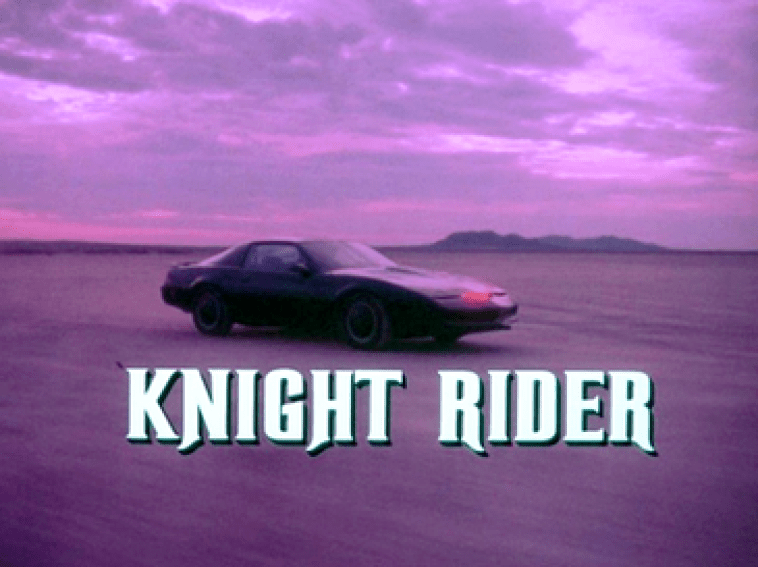
As we downsize, we might recall that on this date in 1982 Knight Rider premiered on television. The show starred David Hasselhoff as crime fighter Michael Knight who drove a customized car– a supercomputer/AI on wheels– named K.I.T.T. (Knight Industries Two Thousand). K.I.T.T. was designed by Michael Scheffe (a designer who had worked on toys for Mattel and on Bladerunner) using Pontiac’s 1982 Trans Am; in the event, he had 18 days to create his first mock up of K.I.T.T. for the network.
The original Knight Rider (1982–1986) and sequel series Team Knight Rider (1997–1998) and Knight Rider (2008–2009) spawned three television films, computer and video games, and novels, as well as KnightCon, a Knight Rider convention.
You must be logged in to post a comment.