Posts Tagged ‘inventors’
How to boldly go where no man has gone before…

As American readers prepare to head for the multiplex for the premiere of Star Trek- Into the Darkness, they might want to take a brief detour down memory lane: Harvard’s Houghton Library has released excerpts of a 31-page photocopied writers’ guide for the original Star Trek series, written in 1967, that was meant to help writers for the then year-old show—as well as prospective writers working on spec scripts—nail the tone and content of a typical “Trek” episode.
The pages list characters and their attributes (Captain Kirk is “a space-age Horatio Hornblower, constantly on trial with himself, a strong, complex personality”), outline dos and don’ts of costuming (no pockets; no space suits), and suggest places where writers working outside the studio can seek technical advice (ask nearby universities, “your local NASA office,” or anyone in the “aero-space research and development industry”).
Coming at the tail end of a decade and a half of science fiction television of variable quality, “Star Trek” was eager to establish itself as a new breed of more realistic space opera. The third page image below describes a scenario in which Captain Kirk comforts a female crewmember as an alien vessel attacks. The guide asks readers to identify the problem with this “teaser.” The answer: “Concept weak. This whole story opening reeks too much of ‘space pirate’ or similar bad science fiction.” Captain Kirk would never hug a fellow crewman as danger approached; he’d be too busy trying to solve the problem.
It’s clear that the guide’s anonymous author knew that those in charge were asking a lot of their writers. At the end of a list of Frequently Asked Questions appears this one:
Q: Are you people on LSD?
A: We tried, but we couldn’t keep it lit.
Read the full story– and read more Writer’s Guide pages– at Slate’s new history blog, The Vault.
More? Check out the ten most under-rated episodes from the original series.
###
As we set phasers to stun, we might spare a thought for Frederick Walton; he died on this date in 1928. The scion of a British rubber processing family, Walton was a prolific inventor. While he patented (among many other things), flexible metal tubing, artificial leather, and a process for waterproofing clothing, he is surely best remembered as the inventor of linoleum.

“Nothing is built on stone; all is built on sand, but we must build as if the sand were stone”*…

Calvin Seibert (Box Builder on Flickr) explains his commitment to his ephemeral craft…
Building “sandcastles” is a bit of a test. Nature will always be against you and time is always running out. Having to think fast and to bring it all together in the end is what I like about it.
I rarely start with a plan, just a vague notion of trying to do something different each time. Once I begin building and forms take shape I can start to see where things are going and either follow that road or attempt to contradict it with something unexpected.
In my mind they are always mash-ups of influences and ideas. I see a castle, a fishing village, a modernist sculpture, a stage set for the oscars all at once.
When they are successful they don’t feel contained or finished. They become organic machines that might grow and expand. I am always adding just one more bit and if time allowed I wouldn’t stop.


See more of Calvin’s modernist monuments to mutability here. Then check out SpongeBob SquarePants‘ “Sandcastles in the Sand.”
[TotH to Colossal]
* Jorge Luis Borges
###
As we gather a collection of rectangular pails, we might spare a thought for Sir James Dewar; he died on this date in 1923. A distinguished chemist and physicist (Dewar was an expert on the liquefaction of the “permanent gases,” conducting his work at temperatures approaching absolute zero), he is probably best remembered as the inventor, in 1892, of the “Dewar flask,” a vacuum-insulated vessel that can keep liquids at hot or cold temperatures for long periods. The first commercial vacuum flasks were made in 1904 by a German company, Thermos GmbH, which patented Dewar’s work (as he had not). Dewar sued to recover his invention, but lost. “Thermos” remains a registered trademark in some countries; but– in a 1963 decision that sent chills down spines at Kleenex (Kimberley-Clark) and Xerox– it was declared a genericized trademark in the US, since it has come to be synonymous with vacuum flasks in general.

Sir James Dewar
“Every body continues in its state of rest or uniform motion in a straight line, except insofar as it doesn’t”*…

N 40° 00’ 00” W 109° 00’ 00” Rangely, Colorado, 2000
Photographer Bruce Myren has taken photos along the 40th degree of latitude across the United States, at every whole degree of longitude…

He explains:
The core idea of this project came to me while I was living for a year in Boulder, Colorado in 1991. A friend and I were sitting on top of Flagstaff Mountain and gazing at the scene. I noticed that the road we drove up, Baseline Road went east in a straight line as far as I could see. I asked my friend if he knew why it was called this. He replied that it was the 40th parallel of latitude, and went on to explain that it was the baseline for creating townships and homesteads, and was a key marker to the settlement of the West. I had a project: I was going to document these arbitrary points of human measurement and the landscape found at the intersections.
And so he did…

N 40° 00’ 00” W 83° 00’ 00” Columbus, Ohio, 1999
Read the whole fascinating story at PetaPixel, and see more of this series and of Myren’s other work on his site.
###
As we trip on tryptophan, we might recall that it was on this date in 1927 that Carl J.E. Eliason received the first patent for a “Vehicle for Snow Travel”– a snowmobile.

“Prediction is very difficult, especially if it’s about the future”*…

Robot-assisted farming
It’s easy to chuckle at the prognostications of yore– where’s my jet pack?!? But as long-time readers will recall, there was one writer whose predictions were uncannily on the money: Jules Verne.

His Paris in the 20th Century, for example, describes air conditioning, automobiles, the Internet, television, even electricity, and other modern conveniences very similar to their real world counterparts, developed years– in many cases, decades– later. From the Earth to the Moon, apart from using a space gun instead of a rocket, is uncannily similar to the real Apollo Program: three astronauts are launched from the Florida peninsula– from “Tampa Town” ( only 130 miles from NASA’s Cape Canaveral)– and recovered through a splash landing. And in other works, he predicted helicopters, submarines, projectors, jukeboxes, and the existence of underwater hydrothermal vents that were not invented/discovered until long after he wrote about them.
Verne’s writings caught the imagination of his countrymen. As Singularity Hub reports,
Starting in 1899, a commercial artist named Jean-Marc Côté and other artists were hired by a toy or cigarette manufacturer to create a series of picture cards as inserts, according to Matt Noval who writes for the Smithsonian magazine. The images were to depict how life in France would look in a century’s time, no doubt heavily influenced by Verne’s writings. Sadly, they were never actually distributed. However, the only known set of cards to exist was discovered by Isaac Asimov, who wrote a book in 1986 called “Futuredays” in which he presented the illustrations with commentary…
In what some French people might consider an abomination, one illustration depicted the modern kitchen as a place of food science. While synthetic food in commercial products is sadly more common today than we’d like to admit (sorry Easy Cheese lovers, but I’m calling you out), the rise of molecular gastronomy in fine dining has made food chemistry a modern reality. It may seem like food science has its limitations, but one only needs to consider efforts to grow meat in a laboratory to see how far technology may go…

“Food Science”
See them all at “19th Century Artists Predicted the Future in This Series of Postcards.”
* Niels Bohr
###
As we console ourselves that, while the future may be another country, we may still speak the language, we might send creative birthday greetings to Hippolyte Mège-Mouriès; he was born on this date in 1817. A rough contemporary of Verne’s, Mège-Mouriès was surely one of the reasons for Verne’s optimism: Mège-Mouriès began his career at age 16 as a chemist’s assistant. By the 1840’s he had improved the syphilis drug, Copahin, after which he patented a variety of creations including tanning, effervescent tablets, paper paste, and sugar extraction. By the 1850s he had turned to food research and developed a health chocolate (featuring a proprietary calcium phosphate protein) and developed a method that yielded 14% more white bread from a given quantity of wheat. After 1862, he concentrated his research on fats– the primary product of which was his invention of margarine (though he also scored yet another another patent, for canned meat).

Sacrificing oneself for Progress…
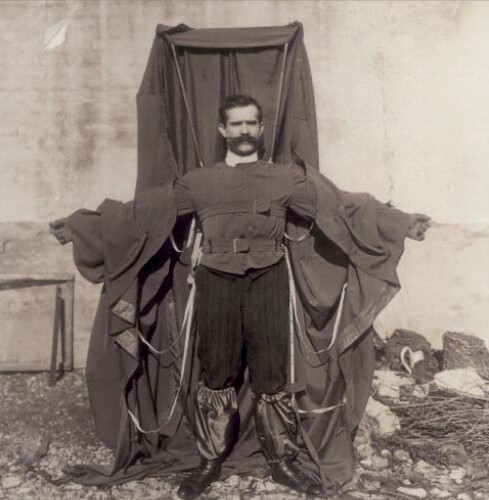 Fred “The Flying Tailor” Reichelt, who died in 1912 when he attempted to use this self-styled garment as a parachute in a jump off of the Eiffel Tower (source)
One is, of course, supposed to practice what one preaches, to eat one’s own dog food. But even as it’s only right to suggest that a physician “heal thyself,” it’s only fair to reference that healer’s Hippocratic Oath, and caution him/her “first, do no harm”…
Consider this List of Inventors Killed By Their Own Inventions.
As we head back to the drawing board, we might recall that it was on this date in 1950 that the daily comic strip Peanuts premiered in eight newspapers: The Washington Post, The Chicago Tribune, The Minneapolis Tribune, The Allentown Call-Chronicle, The Bethlehem Globe-Times, The Denver Post, The Seattle Times, and The Boston Globe. Its creator, Charles Schulz had developed the concept as a strip (L’il Folks) in his hometown paper, The St. Paul Pioneer Press, from 1947 to 1950. At its peak, Peanuts ran in over 2,600 newspapers, with a readership of 355 million in 75 countries, and was translated into 21 languages.

You must be logged in to post a comment.