Posts Tagged ‘fore-edge painting’
“The world was made in order to result in a beautiful book”*…

Revisiting a topic covered here just over a decade ago: Adam Green on the remarkable mid-17th century to the late 19th century practice of publishing books with “hidden art”…
A “fore-edge painting” is an illustration or design which appears on the “fore-edge” of a book (i.e. on the edge which is opened up, opposite to the spine). The history of such embellishments is thought to go back to the tenth century but it wasn’t until the eighteenth century that the unusual practice really began to take off. The simplest form involved painting onto the fore-edge when the book was closed normally — hence the image appears by default — but a more advanced form involved a rather ingenious technique whereby the painting was applied to the page edges when the stack was fanned at a slight angle. This way the image is hidden from view when the book is closed normally. To hide any remnants of this secret image the exposed edge of the book, when closed normally, was gilded (or sometimes marbled). In his 1949 essay “On Fore-Edge Painting of Books” Kenneth Hobson came up with this rather nice metaphor to explain: “Imagine a flight of stairs, each step representing a leaf of the book. On the tread would be the painting and on the flat surface would be gold. A book painted and gilt in this way must be furled back before the picture can be seen.”
Bookbinders, such as Edwards of Halifax, got even cleverer with variations of the technique, producing books with “double fore-edge paintings”, where one image would be revealed when the book was fanned one way, and a second image revealed when fanned the other. “Triple fore-edge paintings” are where a third image is added instead of gilt or marbling. “Panoramic fore-edge paintings” utilise the top and bottom and edges to make continuous panoramic scenes. “Split double paintings” have two different illustrations, one on either side of the book’s centre, meaning that when the book is laid open in the middle, each is seen on either side. Very rare and skilled variations of the art only reveal the image when the the pages of the book are pinched or tented in a certain way.
Most often the artwork would reflect the content of the book (as shown in the chess example above). Sometimes it would depict the owner (through a portrait or picture of their home). And occasionally it would be oddly incongruous, such as The Poetical Works of John Milton being adorned with a painting of the tomb of Thomas Gray.
One of the finest collections of fore-edge paintings is held at Boston Public Library, which you can see on their Flickr, and on a dedicated website, which includes an introductory essay by Anne C. Bromer of Bromer Booksellers, who along with her husband gifted this wonderful collection to the Boston Public Library. In this post we’ve featured our highlights from their collection…
See many more examples at: “Fore-Edge Book Paintings from the Boston Public Library,” from @publicdomainrev.bsky.social.
* Stephane Mallarme
###
As we fan the folio, we might send delightfully-illustrated birthday greetings to Michael Bond; he was born on this date in 1926. A writer of both children’s books and teleplays, he is of course best known as the creator of of Paddington Bear.
Bond published the first of his 29 Paddington books in 1958. The series has sold over 35 million copies worldwide (and been featured in several (mostly) animated television series, a film series, and a stage musical).

“Time will bring to light whatever is hidden”*…
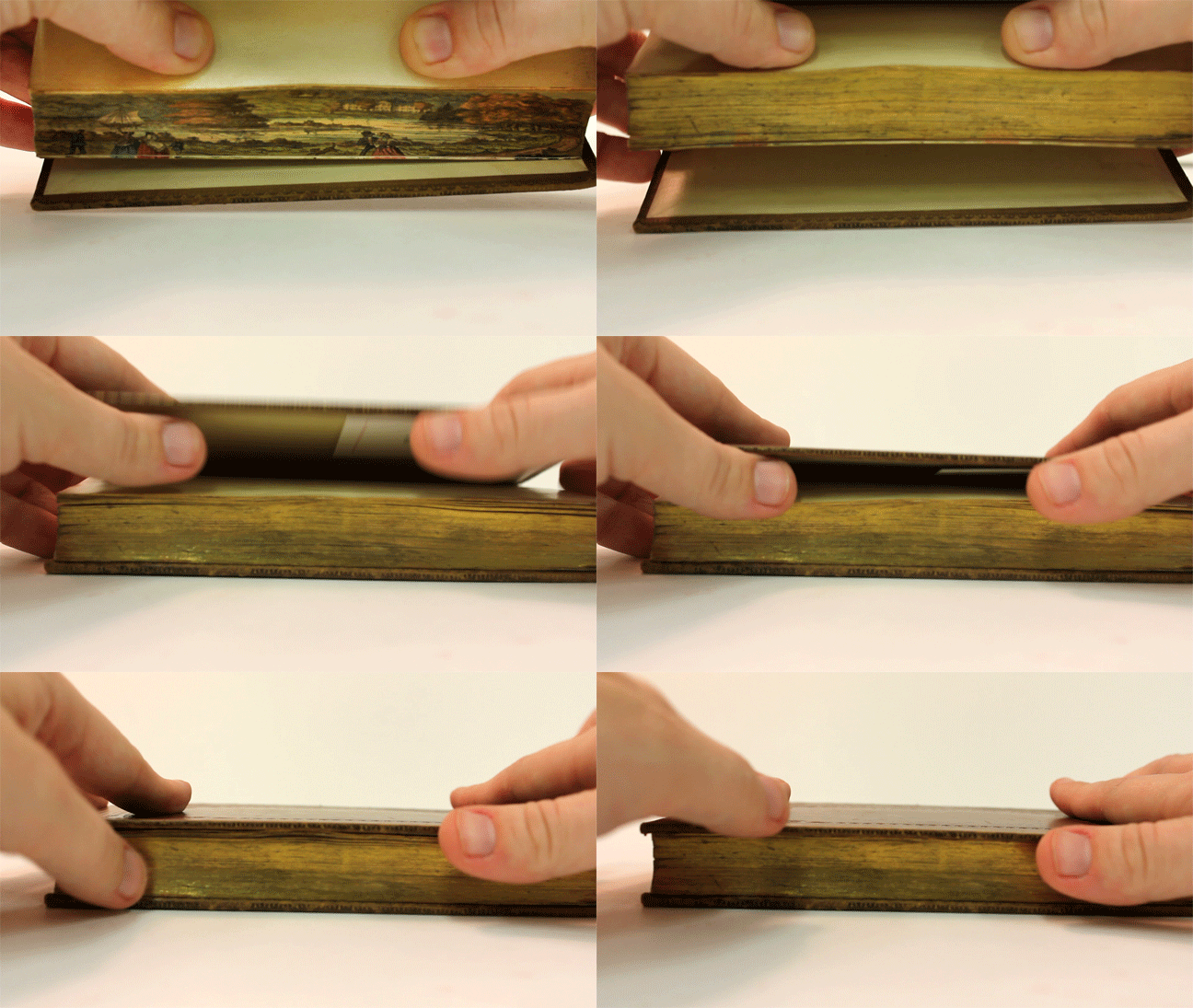

A fore-edge painting is an image on the edges of the pages of a book. The work can only be seen when the pages are fanned (as illustrated in the GIF above and the videos below). When the book is closed, the image is obscured by the gilding– the gold leaf applied to the edges of the page.
email readers click here for video

Fore-edge paintings first arose during the European Middle Ages but came to prominence during the mid-17th century to the late 19th century. Anne C. Bromer for the Boston Public Library [which holds one of the finest collections of fore-edge paintings in the U.S.] writes, “Most fore-edge painters working for binding firms did not sign their work, which explains why it is difficult to pinpoint and date the hidden paintings.”
email readers click here for video

See and read more at “40 Hidden Artworks Painted on the Edges of Books.” See also here, here, and here.
* Horace
###
As we hunt for Easter eggs, we might spare an ecumenical thought for Ramon Llull; he died on this date in 1315 [source]. A philosopher, logician, poet, and theologian who was heavily influenced by Islam, he is credited with the first major work of Catalan literature (the romantic novel Blanquerna), with having anticipated by several centuries prominent work on elections theory, and with pioneering work on computation theory (largely given his influence on Leibniz).
One of the earliest Encyclopedists, he gave up the life of a courtier (to King James of Aragon) first to become a hermit, then a Franciscan. After a 1297 meeting with Duns Scotus, he was given the nickname Doctor Illuminatus.

You must be logged in to post a comment.