Posts Tagged ‘Depression’
“When I give food to the poor, they call me a saint. When I ask why the poor have no food, they call me a communist.”*…
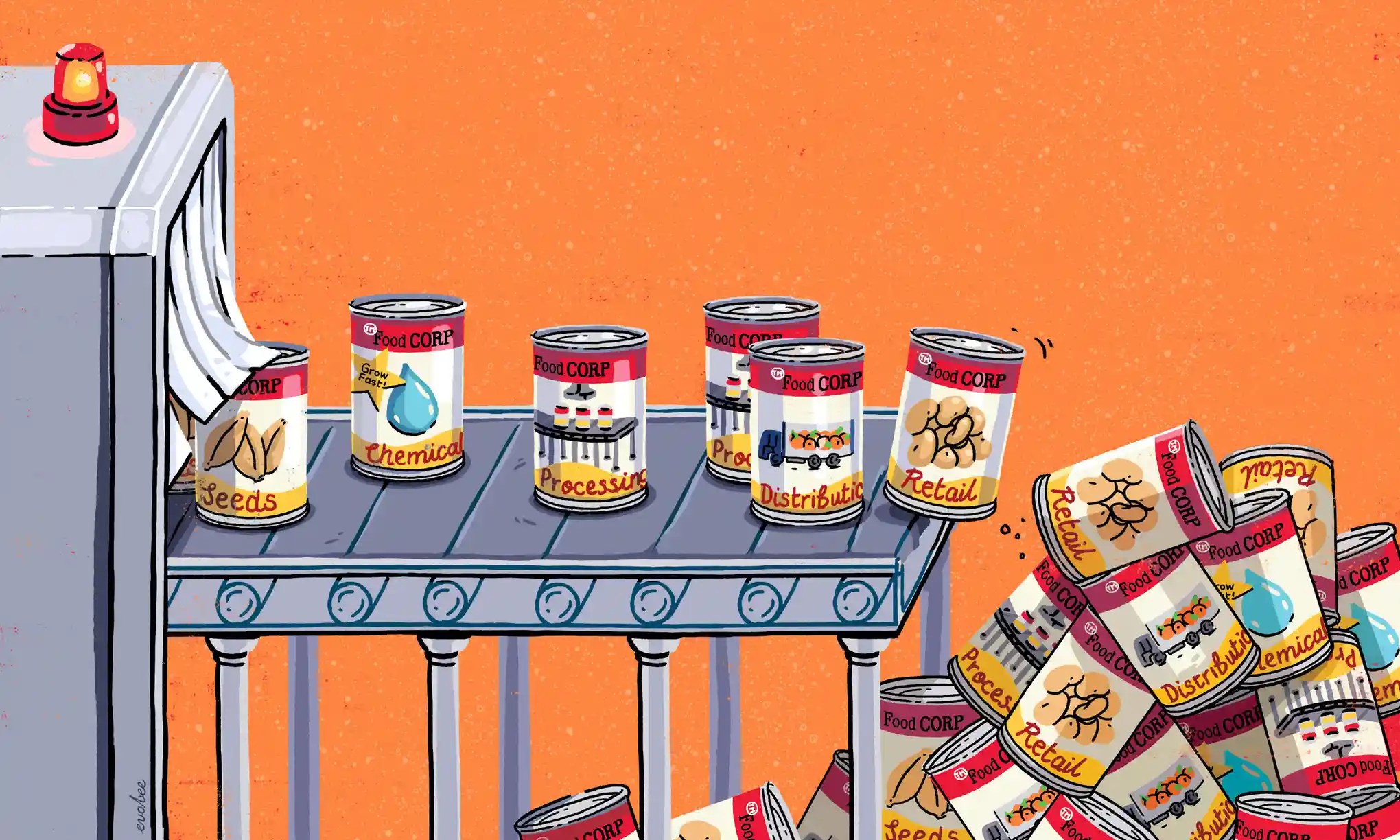
Staying yesterday’s agribusiness theme: George Monbiot on the extraordinary challenges facing the world’s food system…
For the past few years, scientists have been frantically sounding an alarm that governments refuse to hear: the global food system is beginning to look like the global financial system in the run-up to 2008.
While financial collapse would have been devastating to human welfare, food system collapse doesn’t bear thinking about. Yet the evidence that something is going badly wrong has been escalating rapidly. The current surge in food prices looks like the latest sign of systemic instability.
Many people assume that the food crisis was caused by a combination of the pandemic and the invasion of Ukraine. While these are important factors, they aggravate an underlying problem. For years, it looked as if hunger was heading for extinction. The number of undernourished people fell from 811 million in 2005 to 607 million in 2014. But in 2015, the trend began to turn. Hunger has been rising ever since: to 650 million in 2019, and back to 811 million in 2020. This year is likely to be much worse.
Now brace yourself for the really bad news: this has happened at a time of great abundance. Global food production has been rising steadily for more than half a century, comfortably beating population growth. Last year, the global wheat harvest was bigger than ever. Astoundingly, the number of undernourished people began to rise just as world food prices began to fall. In 2014, when fewer people were hungry than at any time since, the global food price index stood at 115 points. In 2015, it fell to 93, and remained below 100 until 2021.
Only in the past two years has it surged. The rise in food prices is now a major driver of inflation, which reached 9% in the UK last month. [Current estimates are that it will be 9% in the U.S. as well.] Food is becoming unaffordable even to many people in rich nations. The impact in poorer countries is much worse.
So what has been going on?…
Spoiler alert: massive food producers hold too much power – and regulators scarcely understand what is happening. Sound familiar? “The banks collapsed in 2008 – and our food system is about to do the same,” from @GeorgeMonbiot in @guardian. Eminently worth reading in full.
Then iris out and consider how agricultural land is used: “Half of the world’s habitable land is used for agriculture.”

… and consider the balance between agriculture aimed at producing food directly and agriculture aimed at producing feed and fuel: “Redefining agricultural yields: from tonnes to people nourished per hectare.”

###
As we secure sustenance, we might send carefully-observed birthday greetings to Dorothea Lange; she was born on this date in 1885. A photographer and photojournalist, she is best known for her Depression-era work for the Farm Security Administration (FSA). Lange’s photographs influenced the development of documentary photography and humanized the consequences of the Great Depression.


“All photographs are accurate. None of them is the truth.”*…

Of the 270,000 photographs commissioned by the US Farm Security Administration to document the Great Depression more than a third were “killed.” As we wrestle with the stories we’re being told, an update of an earlier post…
From his office at the Farm Security Administration (FSA) in Washington, D.C., Roy Stryker saw, time and again, the reality of the Great Depression, and the poverty and desperation gripping America’s rural communities. As head of the Information Division and manager of the FSA’s photo-documentary project, his job was to hire and brief photographers, and then select images they captured for distribution and publication. His eye helped shape the way we view the Great Depression, even today.
Professionally, Stryker was known for two things: preserving thousands of photographs from being destroyed for political reasons, and for “killing” lots of photos himself. Negatives he liked were selected to be printed. Those he didn’t—ones that didn’t fit the narrative and perspective of the FSA at the time, perhaps—were met with the business end of hole punch, which left gaping black voids in place of hog’s bellys, industrial landscapes, and the faces of farmworkers.
In 1935, the Resettlement Administration (RA) was established as part of the New Deal to provide relief, recovery, and reform to rural areas. The FSA, created in 1937, was its spiritual successor. The FSA’s duties included, but were not limited to, operating camps for victims of the Dust Bowl, setting up homestead communities, and providing education to more than 400,000 migrant families. Communicating about its efforts was also part of its mandate…
Stryker sought out photographers, among them Dorothea Lange, Gordon Parks, and Arthur Rothstein, and made their images readily available to the press. Given the lack of new photography and art being produced during the Great Depression, the photos regularly appeared in magazines such as LIFE and Look. He also had them displayed at the 1936 Democratic National Convention, the 1936 World’s Fair, the Museum of Modern Art, and other prominent venues. The publication of a series of early photographs, including Lange’s Migrant Mother, proved instrumental in pushing the federal government to provide emergency aid to migrant workers in California.
In the effort to represent the FSA and Roosevelt’s signature domestic achievement in a positive light, the chosen photos captured how the idealistic views of farm life were being tainted by poverty, and how the FSA programs were helping farmers reclaim their dignity. Common elements were decrepit housing conditions, the lack of food and clean water, and harsh work environments.
It was government propaganda, and there were certainly some within the government (both supporters and detractors) who saw it that way, and more who considered both the FSA and its photography project as communist and un-American. In a 1972 Interview, Stryker admits to having felt political pressure from the Department of Agriculture to portray the effectiveness of the New Deal. “Go to hell,” was his response. His photographers “were warned repeatedly not to manipulate their subjects in order to get more dramatic images, and their pictures were almost always printed without cropping or retouching.”
But there is a way to manipulate the story being told without altering the images themselves—the process of photo editing, of choosing which images to highlight and which to discard…
The fascinating story of one man’s (materially successful) effort to galvanize social and political opinion: “How a Hole Punch Shaped Public Perception of the Great Depression.”
See also “The Kept and the Killed.”
And for an equally-fascinating consideration of how emerging new visual technologies might similarly be used to sway sentiment, read Fred Turner‘s “The Politics of Virtual Reality.”
* Richard Avedon
###
As we contemplate cuts, we might recall that it was on this date in 1940 that the first Social Security check– for $22.54– was issued to Ida May Fuller.
The Social Security Program had been created in 1935, with qualification for eligibility (covered earnings) beginning in 1937. So Ms. Fuller, a teacher-turned legal-secretary, had been accumulating credit for three years. She lived to 100 years old and collected a total of $22,888.

“Everyday, it’s a-gettin’ closer / Goin’ faster than a roller coaster “*…

The American economy is reopening. In Alabama, gyms are back in business. In Georgia, restaurants are seating customers again. In Texas, the bars are packed. And in Vermont, the stay-at-home order has been lifted. People are still frightened. Americans are still dying. But the next, queasy phase of the coronavirus pandemic is upon us. And it seems likely that the financial nadir, the point at which the economy stops collapsing and begins growing again, has passed.
What will the recovery look like? At this fraught moment, no one knows enough about consumer sentiment and government ordinances and business failures and stimulus packages and the spread of the disease to make solid predictions about the future. The Trump administration and some bullish financial forecasters are arguing that we will end up with a strong, V-shaped rebound, with economic activity surging right back to where it was in no time. Others are betting on a longer, slower, U-shaped turnaround, with the pain extending for a year or three. Still others are sketching out a kind of flaccid check mark, its long tail sagging torpid into the future.
At least four major factors are terrifying economists and weighing on the recovery: the household fiscal cliff, the great business die-off, the state and local budget shortfall, and the lingering health crisis…
Annie Lowrey (@AnnieLowrey) unpacks a painfully-plausible worst-case scenario featuring the four horsemen of what could be an economic apocalypse– the four major forces at work today that are terrifying economists and weighing on the recovery: “The Second Great Depression.”
For more on the fourth and most terrifying force Lowrey cites, see here (and the research that underlies it).
* Buddy Holly
###
As we take necessary steps, we might recall that it was on this date in 1867 that Lucien B. Smith patented barbed wire (U.S. No. 66,182). Eventually competitors produced more than 1,500 different types of barbed wire; but Smith’s patent gave him pride of invention. His simple idea that was an artificial “thorn hedge” consisting of wire with short metal spikes twisted on by hand at regular intervals. For prairie farmers and cattlemen natural fencing materials were scarce, so the invention gave them an accessible way keep their cattle safely away from crops. It also created tensions between farmers and ranchers: inexpensive barbed wire allowed farmers to fence in their fields, preventing ranchers’ livestock from feeding off of the farmers’ fields, and making it more difficult for cattle drives to cross farmers’ lands. Ultimately ranchers too recognized the benefits of fencing their herds… and the days of the open range came to an end.
 Copy of Lucien B. Smith’s wire fence improvement (barbed wire) Patent, 66,182, dated June 25, 1867 (source)
“Fortune’s bubbles rise and fall”*…

Gordon Gekko talks tulips. Wall Street: Money Never Sleeps / scottab140
Right now, it’s Bitcoin. But in the past we’ve had dotcom stocks, the 1929 crash, 19th-century railways and the South Sea Bubble of 1720. All these were compared by contemporaries to “tulip mania,” the Dutch financial craze for tulip bulbs in the 1630s. Bitcoin, according some sceptics, is “tulip mania 2.0”.
Why this lasting fixation on tulip mania? It certainly makes an exciting story, one that has become a byword for insanity in the markets. The same aspects of it are constantly repeated, whether by casual tweeters or in widely read economics textbooks by luminaries such as John Kenneth Galbraith.
Tulip mania was irrational, the story goes. Tulip mania was a frenzy. Everyone in the Netherlands was involved, from chimney-sweeps to aristocrats. The same tulip bulb, or rather tulip future, was traded sometimes 10 times a day. No one wanted the bulbs, only the profits – it was a phenomenon of pure greed. Tulips were sold for crazy prices – the price of houses – and fortunes were won and lost. It was the foolishness of newcomers to the market that set off the crash in February 1637. Desperate bankrupts threw themselves in canals. The government finally stepped in and ceased the trade, but not before the economy of Holland was ruined.
Yes, it makes an exciting story. The trouble is, most of it is untrue…
Drawing on ten years of research for her new book, Tulip mania: Money, Honor and Knowledge in the Dutch Golden Age, tells a different story, one that’s just as illuminating, but very different: “Tulip mania: the classic story of a Dutch financial bubble is mostly wrong.”
Like most trends, at the beginning it’s driven by fundamentals, at some point speculation takes over. What the wise man does in the beginning, the fool does in the end.” The world went mad. What we learn from history is that people don’t learn from history. — Warren Buffett, 2006 Berkshire Hathaway annual meeting
* John Greenleaf Whittier
###
As we curb our enthusiasm, we might recall that it was on this date in 1933 that banks began to re-open after the “Bank Holiday” declared by the Roosevelt Administration to calm the market after bank runs had threatened the nation’s financial system during the Depression.

“Only kings, presidents, editors, and people with tapeworms have the right to use the editorial ‘we'”*…

The photos look just like the most famous FSA images of Depression-era America. Laborers with weathered faces stare into the distance, sharecropping families stand on splintered porches and rag-clad children play in the dust.
But each picture is haunted by a strange black void. It hangs in the sky like an inverted sun, it eclipses a child’s face, it hovers menacingly in the corner of a room.
The black hole is the handiwork of Roy Stryker, the director of the FSA’s documentary photography program. He was responsible for hiring photographers such as Dorothea Lange, Walker Evans, Arthur Rothstein and Gordon Parks and dispatching them across the country to document the struggles of the rural poor.
Stryker was a highly educated economist and provided his photographers with extensive research and information to prepare them for each assignment. He was determined to get the best work possible out of his employees — which also made him a bit of a tyrannical editor.
When the photographers returned with their negatives, Stryker or his assistants would edit them ruthlessly. If a photo was not to his liking, he would not simply set it aside — he would puncture the negative with a hole puncher, “killing” it…
More of this sad story– and more punched photos– at “1930s ‘Killed’ photographs.” More on Stryker here.
* Mark Twain
###
As we fill in the blanks, we might recall that it was on this date in 1941 that Diane Nemerov, the privileged daughter of department store owners, married Allan Arbus, a penniless City College student, in New York. Allan went to work in his in-laws’ store, but supplemented his income doing fashion photography– with Diane as his assistant, and later full partner. But after the birth of her second child, Diane found herself drawn to less traditional and more candid subjects– children at first; later “the forbidden.” While Allan continued to run the fashion studio, Diane became noted for photographs of marginalized people—dwarfs, giants, transgender people, nudists, circus performers—anyone whose “normality” was denied by the general public.

“Child with Toy Hand Grenade in Central Park,” New York City (1962)

“Eddie Carmel, Jewish Giant, taken at Home with His Parents in the Bronx,” New York, 1970

photo of Diane Arbus by Allan Arbus (a film test), c. 1949
You must be logged in to post a comment.