Posts Tagged ‘American history’
Failing to fail…

Jia Jiang is an Austin entrepreneur who runs his own technology start-up– a tough gig. The experience of being repeatedly turned down for funding was demoralizing… and led him to conclude that he had to overcome his fear of rejection if he was to become more confident and make his business a success.
So, inspired by a concept called Rejection Therapy, Jiang resolved to make at least one crazy request– and to score a “no”– every day for 100 days. “My goal is to desensitize myself from the pain of rejection and overcome my fear,” he explains on the blog he started to document his quest, 100 Days of Rejection Therapy.
The best laid plans… Jiang hit a bump on the third day of his quest. He walked into a Krispy Kreme in his hometown and asked for the Olympic Rings as donuts. Jackie Braun, the shift supervisor who took the order simply asked when he needed them. “15 minutes,” Jiang replied… and 15 minutes later, Braun returned with these:
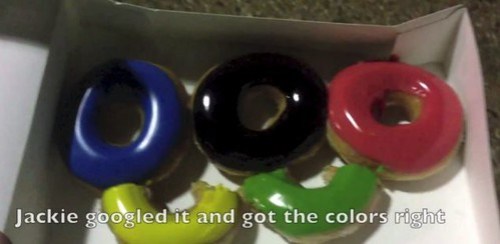
Jiang took his unwanted success philosophically, “I am officially a fan of Jackie at Krispy Kreme.”
Read the whole story at the MailOnline. And follow Jiang’s quest (and see the videos that record his experience with Jackie and his other “assignments”) on his blog; he’s up to Day 13 as of this writing, and hasn’t yet again been surprised by success.
[TotH to Dell Pell’s terrific Next Draft]
###
As we ask directions to the Valley of Death, we might recall that today, the birthday of both Jonathan Swift and Samuel Clemens– Mark Twain– is, appropriately enough, also the birthday of Abbot Howard “Abbie” Hoffman. A political and social activist (and “performance satirist”), Hoffman co-founded the Yippies and was one of the Chicago Seven… among many other colorful acts of protest. (His FBI file ran to 13,262 pages).
Hoffman died in 1989. At his funeral basketball great Bill Walton suggested that “Abbie was not a fugitive from justice; justice was a fugitive from him.” And perhaps more traditionally, Rabbi Norman Mendell said in his eulogy that Mr. Hoffman’s long history of protest, though antic, was “in the Jewish prophetic tradition, which is to comfort the afflicted and afflict the comfortable.”
“Democracy is not something you believe in or hang your hat on, but something you do. You participate. If you stop doing it, democracy crumbles and falls. If you participate, the future is yours.”
– Abbie Hoffman

“Gold is the corpse of value…”*

In the wake of World War I, with metals scarce, Germans faced a shortage of pocket change. So cities, corporations, and sometimes individuals printed and used Serienschein (series notes), a form of Notgeld (emergency money). Circulating from 1917 to 1923, in the run up to the great inflation that presaged the rise of National Socialism, the Serienschein were denominated in small amounts– one Pfennig up to one or two Marks– unlike the Notgeld issued during the great inflation, which were issued in giant denominations, up to $100 million Marks…

And even then, required wheelbarrows for transactions…

But the Serienschein were unlike the huge inflation bills in another way, too: while the Weimar bills were as uniformly drab as the circumstances that spawned them, Serienschein— sourced from many different places, as they were– were hugely various and often strikingly designed…


These fascinating notes began to give way to their drab– but astronomically denominated– successors in 1922, when the European victors in WWI, led by England, demanded their reparations payments in full (and in gold). Reeling still from their loss, and unable to rev their economy sufficiently quickly to cover the vig, the Germans were effectively bankrupted… and reduced to printing money. Printing it as fast as they could. The social toll was huge, and had a profound political effect, paving the way for the rise of Hitler and the Nazis.
One notes that once again a group of European countries, this time ironically led by Germany, is looking to a beleaguered neighbor, this time Greece, for repayment at a time when the Greeks do not have the capacity to earn their way to solvency. (One notes, too, that Spain, Portugal, Italy, and others are trailing perilously closely behind Greece…). So as one watches right-wing nationalist movements gather strength in these debtor nations, one can only hope that the folks with hands on the tillers in Germany (and at the EMU) recall George Santayana’s admonition (in The Life of Reason): “Those who cannot remember the past are condemned to repeat it.”
See more examples of Serienschein here.
*Neal Stephenson, Cryptonomicon
###
As we think again about stuffing our mattresses, we might recall that it was on this date in 1929 that panicked sellers traded nearly 16 million shares on the New York Stock Exchange (four times the normal volume at the time), and the Dow Jones Industrial Average fell 12%. Remembered as “Black Tuesday,” this was the conclusive event in the Crash of 1929, and is often cited as the start of the Great Depression.

All flags flying…

Obesity percentages per state (in alphabetical order, running left to right, from the top left): the “fatter” the star, the more obese the average state resident
Through the month running up to the November election, the San Francisco Museum of Modern Art is featuring the responses of four design firms to the challenge of “re-branding America.”
This week’s entrant, MGMT, started from the observation that the U.S. flag is, in fact, an infographic, representative of both America’s history and its modern identity: 13 stripes = 13 original colonies; 50 stars = 50 states– good as far as it goes, but what else, MGMT asked, might a flag communicate…

Last year, Americans spent over $10 billion on plastic surgery (white). The federal budget for NASA’s space operations was $3.5 billion (red).
Read more about MGMT’s entry here, and see all 50 of their new flags here. Last week’s entrant, Jeremy Mende, took a different tack…

Readers can find Mendes entries here.
###
As we stand to attention and salute, we might recall that it was on this date in 1962 that President John F. Kennedy took to television to report to the nation that Soviet nuclear missiles had been stationed in Cuba, and that in response, the U.S. was launching a naval blockade– and the Cuban Missile Crisis began.
Fifty years later, with the benefit of recently-declassified documents, it’s clear that the crisis was even more dangerous than it felt at the time… and as Ploughshares notes, its effects are with us still.

Re-building America…
A map puzzle that should be simple (for U.S. readers, at least), but may be even more chastening than last Thursday’s…

Click here to play on Jim’s Pages.
###
As we get our bearings, we might recall that it was on this day in 1845 that a majority of the citizens of the independent Republic of Texas approved a proposed constitution, that when accepted by the U.S. Congress and approved by President James Polk later that year, made Texas the 28th puzzle piece– that is, the 28th American state.

The Annexation of Texas to the Union, by Donald M. Yena, 1986. Texas State Library and Archives Commission.
Paileontology…

For school children today, a “lunch box” is a simple and utilitarian affordance (indeed, it’s rarely even a box). But for many readers (and your correspondent), the lunch box was much more than a way to schlep a sandwich; it was a totemic possession. In the days before tee shirts could be worn to school (much less tee shirts with cool logos or designs), a lunch box was a proclamation of allegiance– I dig Lost in Space, I adore Barbie– a step toward public identity and an ingredient in the gel that held adolescent school friends together.
Lunch boxes date back to the 19th century, when working men began to carry them to factories or construction sites or mines to protect their mid-day meals from the perils of the job site.

By the 1880s, school children began to emulate their daddies by making similar caddies out of empty cookie or tobacco tins. The first commercial lunch boxes, which resembled metal picnic baskets decorated with scenes of playing children, came out in 1902. And the first popular character, Mickey Mouse, appeared on a lunch box in 1935.

But the lunch box as personal statement really took off in the 1950s, fueled by television. Executives at a Nashville company called Aladdin realized they could sell more of their relatively indestructible lunch boxes if they decorated them with the ephemeral icons of popular culture: even if one’s Cisco Kid lunch box was barely scratched, one would want to trade in his pail for one featuring Marshall Dillon.

Manufacturers moved from metal to vinyl briefly in the 60s, then switched to molded plastic. But the growth of school lunch programs (and relaxed attire rules, allowing students to wear their enthusiasms) began to eat into the market; Aladdin left the business (though Thermos remains). Today lunch boxes are generally made of vinyl, with foam insulation, and an aluminum/vinyl interior (so that they’re better at retaining their temperature but are less rigid/protective)– and they’re no longer the cultural signifiers that once they were.
Perhaps unsurprisingly then, collecting older lunch boxes has become an active hobby.
Read more at the Smithsonian’s “The History of the Lunch Box” (from whence, the photos above) and see the galleries at the National Museum of American History’s “Taking America to Lunch.”
###
As we wrap our apples, we might recall that it was on this date in 1961 that Congress passed Public Law 87-293, authorizing and funding The Peace Corps.
To promote world peace and friendship through a Peace Corps, which shall make available to interested countries and areas men and women of the United States qualified for service abroad and willing to serve, under conditions of hardship if necessary, to help the peoples of such countries and areas in meeting their needs for trained manpower.
Since 1961, over 200,000 Americans have joined the Peace Corps and served in 139 countries.

President Kennedy greets the first class of volunteers
You must be logged in to post a comment.