Posts Tagged ‘carving’
“Chess pieces are the block alphabet which shapes thoughts”*…

In Amritsar, at India’s oldest and largest chess manufacturing company, artisans have hand-carved the most complicated pieces in the game for generations. Roxanne Hoorn reports…
In the bustling streets of Amritsar, India, the markets are lined with shops full of colorful tapestries and sweet treats like warm local chai served in clay mugs. But the real treasures are kept behind closed doors. Beyond stacks of gnarled logs, inside unsuspecting brick buildings off the main streets, generations of master craftsmen carefully carve, sand, and polish intricate chess pieces, carrying on a long legacy in the country where the earliest versions of chess were played over 1,500 years ago.
These are no basic sets. The pieces make up elaborate professional and collector’s chess sets that sell for up to $4,000 U.S. dollars on the international market. That price is well deserved. Each set is a collective labor of love, with every component handcrafted by a man who specializes in one type of chess piece. (Traditionally, women are not chess carvers.) There are pawn makers, queen craftsmen, and the most coveted—the knight carvers.
“The knight carvers are only knight carvers,” says Rishi Sharma, CEO of the Chess Empire, India’s oldest and largest chess manufacturing company, which was founded in 1962. “The person who is making the queen, we don’t give him the pawn. Otherwise, he’s going to ruin it.”
Of all the chessmen, knights are considered the most difficult and require the most skill to carve. While pawns and other pieces can be shaped under lathes, the knights—resembling horse heads usually with wild flowing manes—are carved completely by hand. A chess carver won’t graduate from pawn to knight or any easier piece to harder ones, but instead will learn his craft from the start of his career, usually from their father or a mentor from one of the well-established chess companies. Surinder Pal, a knight carver at the Chess Empire, learned from his father at 18 years old. Now, he has been working on the craft for over 35 years. With his advanced and highly specialized skill, he can make up to 30 simple knights a day, or spend up to three days on a single ornate knight.
Today, chess pieces are carved from local species like boxwood or imported trees like rose and dogwood. But they were once made of a far more elusive and illicit material. Amritsar was originally known for its ivory carvers, who produced everything from hair combs and jewelry to furniture and sculptures. And of course, chess sets. After the international trade of ivory was banned in the 1990s, the craftsman turned to the similarly smooth but far more accessible medium.
With raw materials readily available, it’s the demand for these fine chess sets that determines how many are produced. And demand has fluctuated in recent years. The COVID-19 pandemic left many people secluded in their homes, leading to a boost in demand for many indoor games, says Sharma. In October 2020, that enthusiasm for chess was compounded by the release of The Queen’s Gambit, a series about a fictional American chess prodigy. “The Queen’s Gambit had a very big role in spreading awareness of chess,” Sharma says. “And after that, we see a big boom.” Despite the show’s creator stating they have no plans for a second season, Sharma stays hopeful. “We hope the next season comes as soon as possible.”…
Equipping the Royal Game: “Masters of the Knight: The Art of Chess Carving in India,” from @atlasobscura.com.
###
As we prize the pieces, we might recall thatt it was on this date in 1996 that then-world chess champion Garry Kasparov and an IBM supercomputer called Deep Blue played game four the first of their two six-game chess matches. They played to a draw. Kasparov won the match– but by a margin of only 4-2 (two draws and a loss to the computer). They met for a rematch the following year, and Big Blue beat Kasparov (3 1/2- 2 1/2).

“Gag me with a spoon!”*…

One weekend a year, the remote hamlet of Milan, Minn. — population 369 — is the center of the spooniverse.
The 11th annual Spoon Gathering, hosted earlier this month by the Milan Village Arts School, attracted more than 150 carvers from nearly 20 states and several foreign countries.These people are the rock stars of this fast-growing pastime. Their soundtrack is the chunk of a finely honed ax biting crisply into a log, the rasp of a file on steel. At once energetic and ruminative, analytical and philosophical, they transform raw wood into the humblest of human tools, a creation as ancient and elemental as a good bowl of bear meat stew…
Whittle on at “How a tiny Minnesota town became the wooden spoon capital of the country.”
* Valley girl speak, quoted in Frank Zappa’s “Valley Girl”
###
As we dig in, we might recall that it was on this date in 1896 that William S. Hadaway, Jr. received the first U.S. patent for an electric stove. It provided a uniform surface distribution of heat from a one-ring spiral coiled conductor.

Pencil it in…
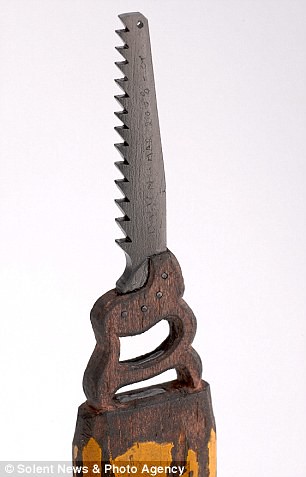
“I’m known as the pencil guy,” laughed Dalton Ghetti, 49. “I don’t mind that at all.”
The Bridgeport artist creates impossibly detailed miniature sculptures on the tip of a pencil.
He shuns a magnifying glass and uses simple tools like razor blades and needles to create delicate little figures – from a tiny, jagged handsaw to a minibust of Elvis in shades…
Readers can find the full, photo-laced story in The NY Daily News (and more in The [U.K.] Daily Mail); and readers in the Northeast can see the Brazilian-born carver’s work at the New Britain Museum of American Art, as part of its “Meticulous Masterpieces” exhibit, through this Sunday.
(Many thanks to reader PL.)

As we ponder altogether new meanings for “sharpen my pencil,” we might recall that it was on this date in 1940, at the New York World’s Fair, that the world’ first Parachute Wedding was conducted. Arno Rudolphi and Ann Hayward, were married on the Parachute Jump, a 26-story high ride created for the World’s Fair (though now working on Coney Island). The entire wedding party– minister, bride, groom, best man, maid of honor & four musicians– was suspended aloft until the newlyweds completed their vows.

You must be logged in to post a comment.