“Patience’s design flaw became obvious for the first time in my life: the outcome is decided not during the course of play but when the cards are shuffled, before the game even begins. How pointless is that?”*…
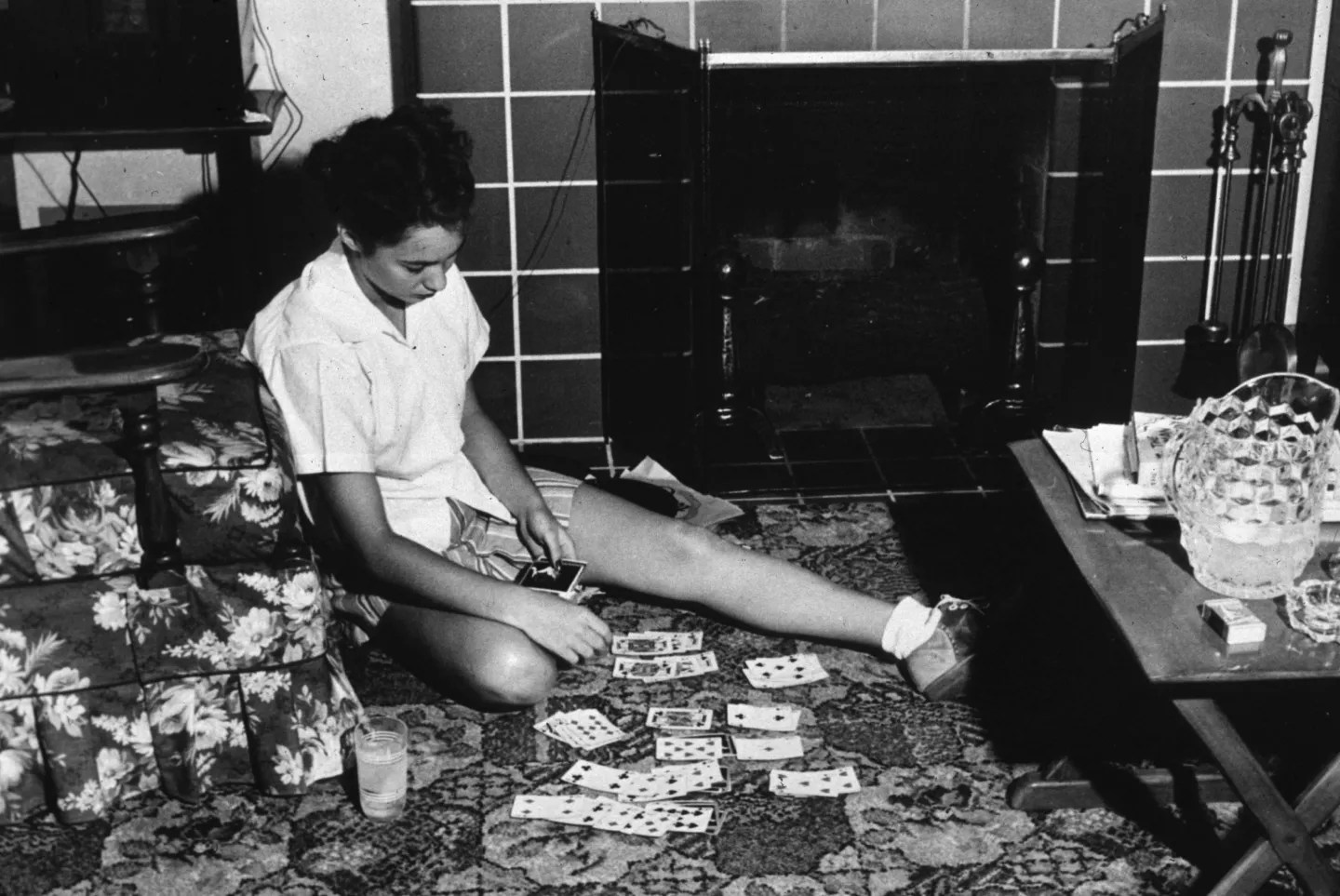
As Simone de Rochefort explains, Patience– or as we tend to know it, solitaire— illustrates the way in which some of humanity’s oldest toys are our most complex…
… last year, I got addicted to Solitaire.
Why me.
During the dark final days of 2024, I was averaging 12 wins per day in Sawayama Solitaire, one of the Solitaires created by developer Zachtronics. Sawayama Solitaire is a variant of Klondike — the one that’s been bundled into every version of Windows since 1990.
Some games of Sawayama Solitaire felt impossible. Some were absurdly easy. Most of them were a satisfying detangling of cards that had me immediately pressing that “new game” button once I got the win.
How was the most basic card game on Earth owning my life like this?
I think it’s because we don’t understand playing cards.
In 1969, as protests raged against the Vietnam War and counterculture made waves across the nation, a magician [and dear friend of Ricky Jay] named Persi Diaconis went to college.
Diaconis had been a professional magician since age 14, and was skilled in sleight-of-hand tricks. But it was probability that fascinated him.
He went on to take a degree in statistics. He became a world-renowned mathematician. In 1992, he proved that it takes seven riffle shuffles to truly randomize a 52-card deck, alongside fellow mathematician Dave Bayer. His research on card shuffling has implications for scientific fields as far-flung as the study of glass melting and the creation of magnets.
He doesn’t know how Solitaire works.
“One of the embarrassment of applied probability is that we can not analyze the original game of solitaire,” he wrote in the abstract for an academic talk called “The Mathematics of Solitaire,” given at the University of Washington in 1999. The talk has been given several times over the years, and is currently viewable on YouTube. One of his most recent appearances, in 2024, reiterates that despite all the technical advances we’ve made in science and mathematics, the complexity of cards is still somewhat a black box.
“What’s the chance of winning, how to play well, how do various changes of rules change the answers?” Diaconis wrote. “Surely you say, the computer can do this. Not at present, not even close.”
It’s not hard to see the relationship between magic and math. Cards contain limitless possibilities. In fact, math tells us there are more combinations of cards in a 52-card deck than there are atoms on Earth.
Writing for Quanta Magazine, Erica Klarreich asked mathematician Ron Graham what that means in practice. He told her, “If everyone had been shuffling decks of cards every second since the start of the Earth, you couldn’t touch 52 factorial,” the number of possible arrangements of a 52-card deck. Klarreich goes on: “Any time you shuffle a deck to the point of randomness, you have probably created an arrangement that has never existed before.”
So that’s nuts…
More amazement at “No one understands how playing cards work,” from @polygon.com.
And here:
* David Mitchell, Cloud Atlas
###
As we shuffle along, we might spare a thought for Christiaan Huygens; he died on this date in 1695. A mathematician, physicist, engineer, astronomer, and inventor, he was a key figure in the Scientific Revolution. In physics, Huygens made seminal contributions to optics and mechanics, while as an astronomer he studied the rings of Saturn and discovered its largest moon, Titan. As an engineer and inventor, he improved the design of telescopes and invented the pendulum clock, the most accurate timekeeper for almost 300 years. A talented mathematician and physicist, his works contain the first idealization of a physical problem by a set of mathematical parameters, and the first mathematical and mechanistic explanation of an unobservable physical phenomenon.
Relevantly to the piece above, Huygens also contributed to the development of probability theory and statistics. In 1665 he visited Paris and encountered the work of Fermat and Pascal, which led him to write what was, at the time, the most coherent presentation of a mathematical approach to games of chance in De Ratiociniis in Ludo Aleae (On reasoning in games of chance)– a work contains early game-theoretic ideas.

You must be logged in to post a comment.