“A good photograph is knowing where to stand”*…

Today’s post– commemorating the 124th birthday of a man who knew exactly where to stand– reverses (Roughly) Daily‘s usual format, opening with the almanac entry…
We might send thoughtfully-composed birthday greetings to Ansel Adams; he was born on this date in 1902. A photographer who specialized in landscapes, especially in black-and-white photos of the American West, he was hugely influential both in photography and in environmentalism.
Adams helped found Group f/64, an association of photographers advocating “pure” photography which favored sharp focus and the use of the full tonal range of a photograph; was a key advisor in establishing the photography department at the Museum of Modern Art in New York, and a founder of the photography journal Aperture.
His love of photography was born when, at age 12, he visited Yosemite and took his first shots. He became a life-long advocate for environmental conservation, a commitment deeply intertwined with his photographic practice. At one point, he contracted with the United States Department of the Interior to make photographs of national parks. For his work and his persistent advocacy, which helped expand the National Park system, he was awarded the Presidential Medal of Freedom in 1980.
Visit the Ansel Adams Gallery to see more of Adams’ signature lanscape and natural wonder work.

Adams, c. 1950 (source)
###
On the occasion of Adams’ birthday, we might note that, working photographer that he was, he took commercial assignments from time to time– assignments focused on subjects not usually associated with Adams. Two of them are especially interesting…
A collection of photos taken for Fortune Magazine in Los Angeles in the run-up to World War II documented the lives of workers in Los Angeles’ booming aviation industry…


More at “Ansel Adams’ Photos of Pre-War Los Angeles.”
And then, from the early 1960s, photos taken by Adams for Stanford’s PACE Program…
“Once it was a rich, sleepy school with rich, sleepy students; now it aims to be the ‘Harvard of the West’.” That was how Time magazine described Stanford University in the fall of 1962. The publication had been reporting on Stanford’s PACE program, a massive fundraising effort that the school launched to strive toward the kind of prominence that its founders Leland and Jane Stanford had originally envisioned. The core drive behind PACE, an acronym for Plan of Action for a Challenging Era, was for Stanford to transcend its “sleepy” backwater reputation (the “rich” part would remain) and emerge as a potential Western rival to the Ivy League universities on the East Coast.
When it came to PACE’s promotional materials for wooing donors, Stanford’s planning department hired Ansel Adams to produce the visuals. Adams was already well known and highly accomplished at the time, having shot the majority of his masterpiece landscapes depicting the natural grandeur of the American West. But in the early 1960s, he was also still a for-hire photographer trying to make a living in the Bay Area. According to archival letters, Adams and his team of photographers were contracted for $3,000 to produce a series of images from around the Stanford campus over a period of two months in early 1961.
The PACE program ultimately proved to be a resounding success, to the tune of $114 million in fundraising (nearly $1.1 billion today), which became foundational to Stanford’s present-day status as an ultra-elite university. In parallel fashion, Adams would eventually be considered the great American photographer of his era, an exceedingly rare household name in the world of photography, and a visual artist still highly celebrated in museums and pricey galleries around the world. However, his series of Stanford photographs was never recorded in his otherwise meticulous photo log and fell into deep obscurity, becoming all but never-before-seen images by the general public and unknown to even his biographers and archivists…
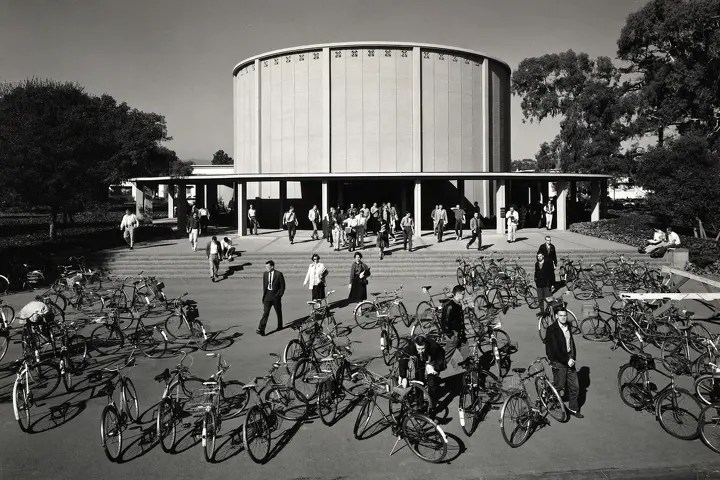

More at “Lost California photos from Ansel Adams.”
* Ansel Adams
You must be logged in to post a comment.