“Planchet, my friend, said d’Artagnan, you reason like a cheese.”*…
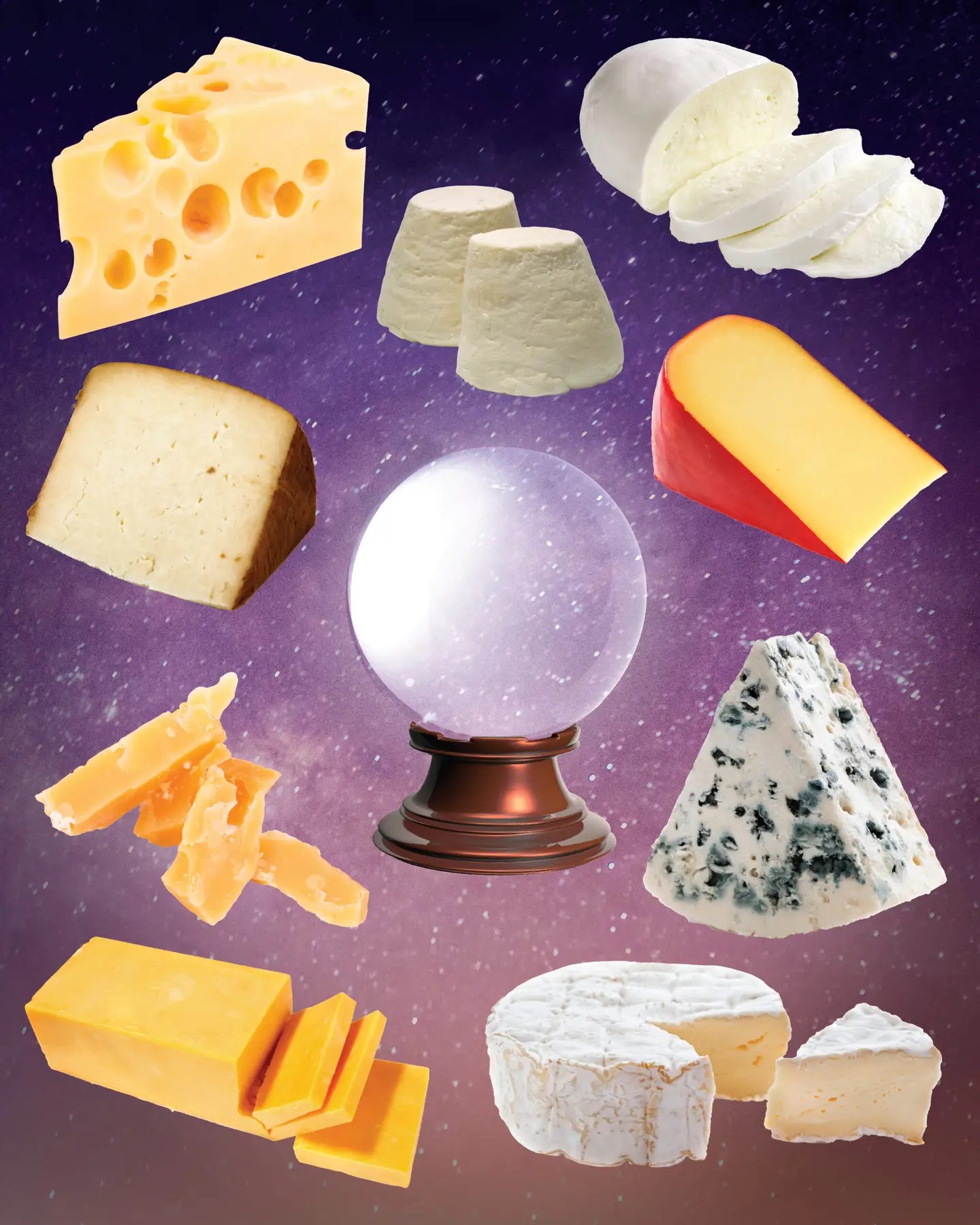
An age-old fortune-telling practice uses cheese to predict everything from one’s future spouse to one’s next career move…
A few months ago, I told a chef in Vancouver that he would soon experience major growth in his career and take on much more responsibility, and that the letter B would somehow be involved. How did I know? Some cheese told me. He’d been standing next to a particularly veiny piece of blue cheese, and asked me to read his fortune from it. Predicting the future using cheese is something I do as a side business, and from what I can tell, there aren’t very many of us doing this anymore.
This isn’t some cheesy divination method I just made up. Tyromancy, or the practice of telling fortunes with cheese, was first officially mentioned in the second century in the writings of Greek historian and professional diviner Artemidorus of Daldis (also known as Artimedorus of Ephesus) on dream interpretation. He apparently didn’t think cheese was a great invention: he noted at the time that the food signifies “trickery and ambushes” and that tyromancers sullied the work of true diviners like sacrificers and liver examiners. Tyromancers, he argued, were more in league with those who practiced evil types of divination, including dice diviners and necromancers. It feels like a bit of a leap to go from cheese to death, but Artimedorus had some opinions, I guess.
Tyromancy reached peak popularity in England during the Middle Ages and early modern period (1500–1800). The country was primarily an agrarian society at the time, with most families having some sort of livestock that produced milk for cheese—and people loved to dabble in the paranormal. Christianity was ingrained in most people, so looking for insight into one’s predestined future, or trying to find a way to gain control over it, led to widespread interest in divination. One used whatever tools were on hand to achieve that, and at that particular point in history, that meant cheese. It was a much more convenient choice than previous divination methods, which included dumping a ladle of molten lead into a bucket of water to see what shapes it made.
People used cheese to divine all sorts of things: who committed a crime, whether the year would bring a fruitful harvest, and how a child’s life would turn out. Those who practiced it generally used farmer’s cheese, though some tried it with runnier options, like fondue.
Back then, a typical use for tyromancy was to determine who you would marry. You’d simply carve the names of all potential suitors into some pieces of cheese, then wait to see which one molded first. And there it was—your life partner! People also analyzed the number and size of holes in a block of cheese, the patterns of the mold and veins, and the shapes that curds made as they coagulated. The process is similar to that of reading tea leaves or coffee grounds—you tell a story through the shapes you see. A heart shape, for example, signifies love and happiness, while an odd number of holes predicts that something negative might happen…
“The Un-Brie-Lievable History of Tyromancy,” from @JenniferBillock in @SAVEURMAG.
* Alexandre Dumas
###
As we foretell with fromage, we might send distributed birthday greetings to Oveta Culp Hobby; she was born on this date in 1905. A journalist, (self-described) businesswoman, and government official, she is best remembered as the first Secretary of Health, Education, and Welfare (a position she took in 1953 on appointment by Dwight Eisenhower). While her most notable achievement in that role was surely the approval and mass roll-out of the polio vaccine, she also worked with her counterpart in the Department of Agriculture to establish the program under which excess cheese production was bought by the government and distributed to public schools for use in their lunch programs.

You must be logged in to post a comment.