Archive for August 2008
What’s in a name?…
Your correspondent, for one, has always puzzled over what piece of furniture he would be, if in fact he were a piece of furniture… and over what the name of that fixture– his name– would be. Happily for those similarly puzzled, the good folks at Blogadilla have created the Swedish Furniture Name Generator. One simply enters a name– for example, “Nora”– and viola:

One can try it oneself here.
As we rearrange our rooms, we might wish an altitudinous birthday to Joseph-Michel Montgolfier, the inventor (with brother Jacques Étienne) of the hot air balloon; he was born on this date in 1740.

Oaky, with subtle fruit tones… and a certain chimeral character…
What does it take to get a Wine Spectator Award of Excellence for a restaurant’s wine list?… amusingly, neither a sterling selection nor even a real restaurant.

In the course of his academic research, Robin Goldstein (author of The Wine Trials) PhotoShopped a menu and wine list for an imaginary restaurant, then sent them– with a $250 fee– to Wine Spectator… which honored his establishment with its Award of Excellence (in the August 2008 print issue and online). Goldstein went public with the experiment in a paper he presented on August 15 at an economics conference; not surprisingly, Wine Spectator has removed the award from its site (though the screen shot above is available on Goldstein’s, via the link at the top of this note). Goldstein observes:
The main wine list that I submitted was a perfectly decent selection from around Italy that met the magazine’s basic criteria (about 250 wines, including whites, reds, and sparkling wines–some of which scored well in WS). However, Osteria L’Intrepido’s [Goldstein’s fantasy eatery’s] high-priced “reserve wine list” was largely chosen from among some of the lowest-scoring Italian wines in Wine Spectator over the past few decades.
While it’s interesting that the reserve list would receive such seemingly little scrutiny, the central point is that the wine cellar doesn’t actually exist. And while Osteria L’Intrepido may be the first to win an Award of Excellence for an imaginary restaurant, it’s unlikely that it was the first submission that didn’t accurately reflect the contents of a restaurant’s wine cellar.
As we emptors caveat, we might recall that it was on this date in 1609 that Galileo presented his new 30X telescope to the Senate of Venice. He used it, starting the very next month, to make the observations of Venus– he saw it go through a full set of phases like those of the moon– that supported (even if it didn’t prove) Copernicus’ heliocentric model of the solar system… and effectively disproved the Ptolemaic geocentric model… it was, of course, precisely this heliocentrism that later landed Galileo in trouble with the Church.
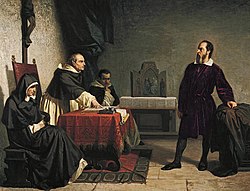
Cristiano Banti’s 1857 painting of Galileo facing the Roman Inquisition
Out-getting the vote…

From the ever-insightful xkcd.com. (And in case one’s not yet caught up with the underlying story– voting machines used in 34 states have software that causes votes to be dropped– see this Washington Post article.)
As we recalculate the value of our franchise, we might sketch a birthday cartoon for Sir Henry Maximilian “Max” Beerbohm, parodist and caricaturist, born this date in 1872. Asked about the exactness of his observations of English society, Beerbohm observed, “To give an accurate and exhaustive account of the period would need a far less brilliant pen than mine.”

Two of Beerbohm’s self-portraits.”The Theft”
depicts him stealing a book from the library in
1894. “The Restitution” shows him returning
that book in 1920.
Non-Sequiturs from Around the World, Part 42…
From the good folks at Blogadilla (“the Tijuana of the Internet”), a list a handy phrases to interject just as a new member is joining a conversation:
Best ‘Out of Context’ phrases to disturb people who have just joined the conversation:
• And that’s why you should never eat movie theater hot dogs.
• Because it was technically “art,” they had to drop the charges.
• So they named the medical condition after me.
• And that’s why I am no longer welcome in Turkey.
• So I’ve been out of prison for 2 years and I still like to do it.
• And so my childhood best friend will soon be my step-son.
• Because I didn’t know that the restraining order applied to the entire cemetery.
• So we were disqualified from the Iditarod because they weren’t technically dogs.
• And I still have it in a jar of formaldehyde in my closet.
• And the residents of Nukumanu Island still regard me as a god.
• Because she was my second cousin, the State of Arkansas had no case against us.
• Because ‘Baby Fighting’ is technically legal in Guatemala.
• And now the security at Disneyland has the right to shoot me on sight.
• Because we thought ‘Nursing School’ meant something totally different.
As we choose our words and wait for our openings, we might recall that it was on this date in 1500 that Christopher Columbus was arrested (by the co-Governor recently arrived from Spain) for crimes against the people of Haiti; Columbus and his two brothers were returned to Spain in chains on October 1 of that same year.

![Reblog this post [with Zemanta]](https://i0.wp.com/img.zemanta.com/reblog_e.png?w=700)
History never repeats itself, but it rhymes…
Gustave Gilbert, a German-speaking intelligence officer and psychologist was granted free access by the Allies to all the war crimes prisoners held in the Nuremberg jail. Gilbert kept a journal of his observations of the proceedings and his conversations with the prisoners, which he later published in the book Nuremberg Diary. On the evening of April 18, 1946, as the trials were recessed for a three-day Easter break, Gilbert had a conversation with Hermann Goering in Goering’s cell…
We got around to the subject of war again and I said that, contrary to his attitude, I did not think that the common people are very thankful for leaders who bring them war and destruction.
“Why, of course, the people don’t want war,” Goering shrugged. “Why would some poor slob on a farm want to risk his life in a war when the best that he can get out of it is to come back to his farm in one piece. Naturally, the common people don’t want war; neither in Russia nor in England nor in America, nor for that matter in Germany. That is understood. But, after all, it is the leaders of the country who determine the policy and it is always a simple matter to drag the people along, whether it is a democracy or a fascist dictatorship or a Parliament or a Communist dictatorship.”
“There is one difference,” I pointed out. “In a democracy the people have some say in the matter through their elected representatives, and in the United States only Congress can declare wars.”
“Oh, that is all well and good, but, voice or no voice, the people can always be brought to the bidding of the leaders. That is easy. All you have to do is tell them they are being attacked and denounce the pacifists for lack of patriotism and exposing the country to danger. It works the same way in any country.”
Nuremberg Diary is available online (in part) via Google Books here; it is available from Amazon here.
As we recall Santayana’s sage advice (or for that matter, Mark Twain’s in the title), we might recall that it was on this date in 1485 that the House of Lancaster finally defeated the House of York in the thirty-year Wars of the Roses, fought for the throne of England. The final battle was at Bosworth Field, near Leicester, where Henry Tudor (later, Henry VII) was victorious; and Richard III, killed.

You must be logged in to post a comment.