Archive for August 2008
Where there’s a will…
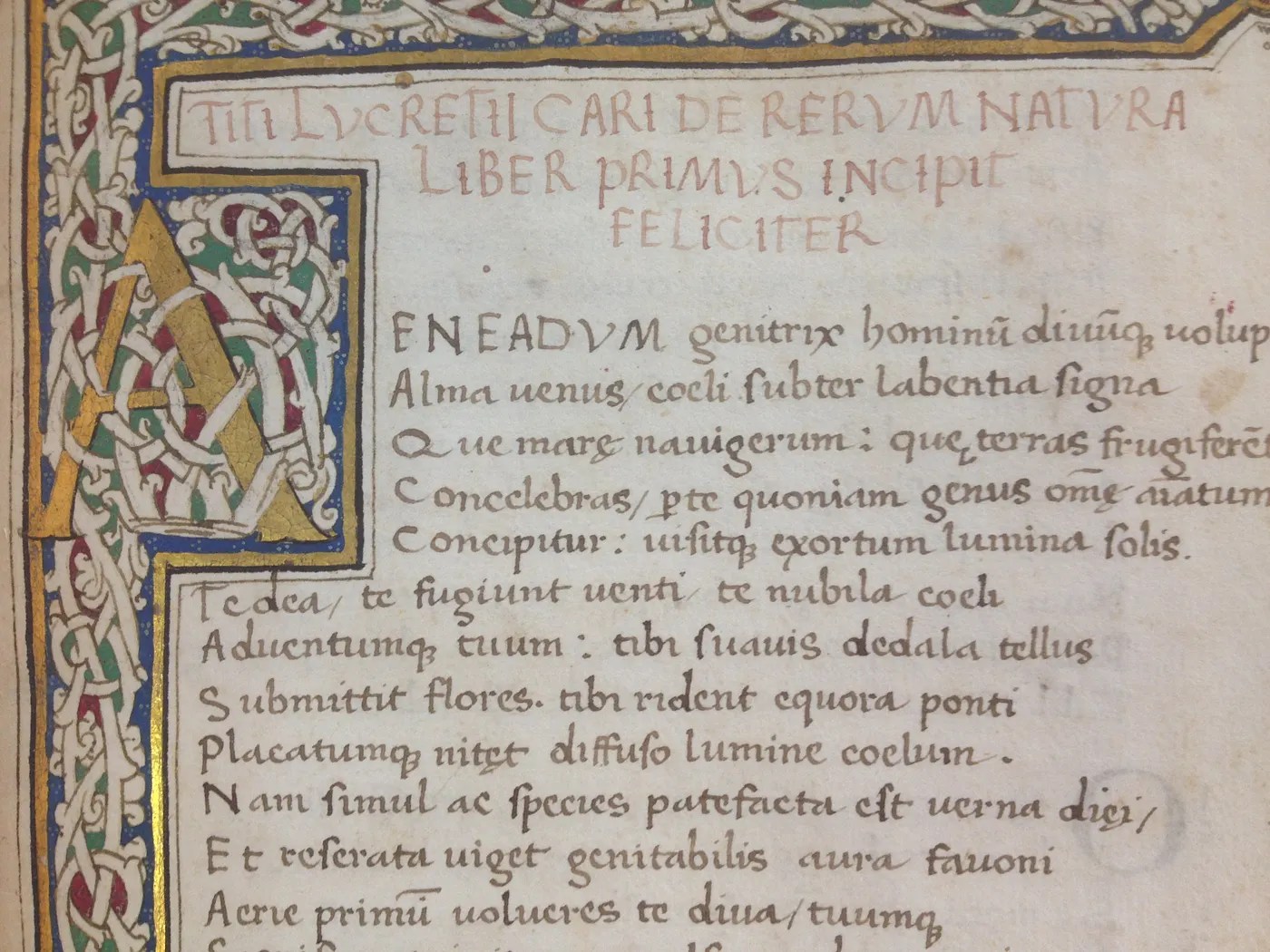
If the atoms never swerve so as to originate some new movement that will snap the bonds of
fate, the everlasting sequence of cause and effect—what is the source of the free will possessed by living things throughout the earth?
-Titus Lucretius Carus, Roman philosopher and poet, 99–55 BC.
Do rational beings have free will— control over their actions and decisions? The question has haunted philosophical debate (and as a consequence, both scientific and social research) from the dawn of culture.
Now, in a move not likely to make the issue any clearer, two highly-regarded Princeton mathematicians, John Conway and Simon Kochen, claim to have proven that if humans have even the tiniest amount of free will, then atoms themselves must also behave unpredictably.
The finding won’t give many physicists pause; traditional interpretations of quantum mechanics already embrace unpredictability. The best anyone can hope to do, quantum theory says, is predict the probability that a particle will behave in a certain way.
But another group physicists, from Einstein (“God does not play dice”) on, have been unhappy with this idea since the birth of quantum theory and Heisenberg’s expounding of The Uncertainty Principle. Indeed, some have offered alternate interpretations of the quantum equations that aim to get rid of this indeterminism– most famously, physicist David Bohm, who argued in the 1950s that the behavior of subatomic particles is entirely determined by “hidden variables” that cannot be observed. (For a marvelous account of this debate, and Bohm’s role in it, see John Casti’s The One True Platonic Heaven.)
Conway and Kochen say “good luck with that”; they claim to have proven that indeterminacy is inherent in the (macroscopic) world itself, not just in (the microscopic realm of) quantum theory. To Bohmians and other neo-Classicists, the pair says: give up determinism, or give up free will… even the tiniest bit of free will.
Read the report in Science News, replete with critiques from the unconvinced and testimonials from the converted, here.
[Image above, from an essay on Lucretius, Epicurean physics and free will]
As we consider our options, we might sketch a birthday card for Isadore “Friz” Freleng, an animator, cartoonist, director, and producer, born this date in 1906. Best known for his work on the Looney Tunes and Merrie Melodies series of cartoons from Warner Bros., he introduced and/or developed several of the studio’s biggest stars, including Bugs Bunny, Porky Pig, Tweety Bird, Sylvester the cat, Yosemite Sam (to whom he was said to bear more than a passing resemblance) and Speedy Gonzales. The senior director at Warners’ Termite Terrace studio, Freleng was also the most honored of the Warner directors, winning four Academy Awards. After the 1963 closing of the Warners animation studio, Freleng and business partner David DePatie founded DePatie-Freleng Enterprises, which produced, probably most notably, The Pink Panther… a character who knew a little something about indeterminacy.

Some things never change…
Readers may recall an earlier missive regarding Philogelos (The Laughter-Lover) the oldest extant joke book, compiled in the 4th/5th Century CE. The helpful folks at Dave, a British cable/satellite channel, have taken the excavation a step further, funding research at the University of Wolverhampton to identify the ten oldest (surviving) jokes in the world. Entries from Philogelos are the last (most recent) two on the list. The oldest?
1. Something which has never occurred since time immemorial: a young woman did not fart in her husband’s lap (1900 BC – 1600 BC Sumerian Proverb Collection 1.12-1.13)
2. How do you entertain a bored pharaoh? You sail a boatload of young women dressed only in fishing nets down the Nile and urge the pharaoh to go catch a fish (An abridged version first found in 1600 BC on the Westcar Papryus)
3. Three ox drivers from Adab were thirsty: one owned the ox, the other owned the cow and the other owned the wagon’s load. The owner of the ox refused to get water because he feared his ox would be eaten by a lion; the owner of the cow refused because he thought his cow might wander off into the desert; the owner of the wagon refused because he feared his load would be stolen. So they all went. In their absence the ox made love to the cow which gave birth to a calf which ate the wagon’s load. Problem: Who owns the calf?! (1200 BC)
For the remainder of the equally Catskills-ready rundown, click here. Read the Reuters backgrounder here.
As we work on our patter, we might wish a racy birthday to Jacqueline Susann, whose 1966 novel, Valley of the Dolls, is the best-selling novel of all time (having sold over 30 million copies so far, 2 million more copies worldwide than Margaret Mitchell’s Gone With the Wind, its closest competition); she was born in Philadelphia on this date in 1918.

Oh, I see…

Designer Chueh Lee of Samsung China has designed what may be the worlds first camera for the blind, the “Touch Sight”… that’s right, a camera for the blind. Chueh explains:
Touch Sight is a revolutionary digital camera designed for visually impaired people. Simple features make it easy to use, including a unique feature which records sound for three seconds after pressing the shutter button. The user can then use the sound as reference when reviewing and managing the photos. Touch Sight does not have an LCD but instead has a lightweight, flexible Braille display sheet which displays a 3D image by embossing the surface, allowing the user to touch their photo. The sound file and picture document combine to become a touchable photo that is saved in the device and can be uploaded to share with others–and downloaded to other Touch Sight cameras.
Learn more on the Yanko Design Blog.
As we recalibrate our senses, we might recall that it was on this date in 14 CE that Gaius Julius Caesar Octavianus Augustus— the Roman emperor Augustus– uttered his final words, a deathbed query to his friends: “If I have played my part well, clap your hands, and dismiss me with applause from the stage” (Alternately translated: “Do you think I have played my part pretty well through the farce of life?”).

Can you hear me now?…
The Telemegaphone Dale is a seven-meter “loudspeaker sculpture” that sits atop Bergskletten mountain overlooking the Dalsfjord in Western Norway. When one calls its phone number (+4790369389), one’s voice is projected out across the fjord, the valley and the village of Dale below.

The Telemegaphone’s creators, Unsworn Industries, are based miles and miles away, in Sweden. The people of Dale are apparently working on a jamming mechanism.
As we rehearse our yodels, we might recall that it was on this date in 1958 that Vladimir Nabokov’s already-controversial novel Lolita was published in the USA; it had been published (in English) in Paris three years earlier.

Nomen est omen…
Mitja D. Back, Stefan C. Schmukle, Boris Egloff, of the University of Leipzig, have just published “How Extroverted is honeybunny77@hotmail.de?”– an exploration of the extent to which email addresses conjure specific stereotypes (implied identities) in the mind of the recipient, and the extent to which those stereotypes are accurate…
From the abstract:
Computer mediated communication (CMC) plays a rapidly growing role in our social lives. Within this domain, e-mail addresses represent the thinnest slice of information that people receive from one another. Using 599 e-mail addresses of young adults, their self-reported personality scores and the personality judgments of 100 independent observers, it was shown that personality impressions based solely on e-mail addresses were consensually shared by observers. Moreover, these impressions contained some degree of validity. This was true for neuroticism, openness, agreeableness conscientiousness, and narcissism but not for extroversion. Level of accuracy was explained using lens model analyses: Lay observers made broad use of perceivable e-mail address features in their personality judgments, features were slightly valid and observers were sensitive to subtle differences in validity between cues. Altogether, even the thinnest slice of CMC– the mere e-mail address—contains valid information about the personality of its owner.
Download the paper here…
As we rethink our handles, we might wish a discretely bawdy happy birthday to Mary Jane “Mae” West, actress, playwright, screenwriter, and bombshell, born on this date in 1893. Among her memorable mots:
Too much of a good thing is wonderful.
When choosing between two evils I always like to take the one I’ve never tried before.
To err is human, but it feels divine.
Between two evils, I always pick the one I never tried before.
I generally avoid temptation unless I can’t resist it.

You must be logged in to post a comment.