Posts Tagged ‘Ragnarok’
“The mind was dreaming. The world was its dream.”*…

Further to yesterday’s piece, a dreamy allegory from Jorge Luis Borges: his (very short) story “Ragnarök” in its entirety:
The images in dreams, wrote Coleridge, figure forth the impressions that our intellect would call causes; we do not feel horror because we are haunted by a sphinx, we dream a sphinx in order to explain the horror that we feel. If that is true, how might a mere chronicling of its forms transmit the stupor, the exultation, the alarms, the dread, and the joy that wove together that night’s dream? I shall attempt that chronicle, nonetheless; perhaps the fact that the dream consisted of but a single scene may erase or soften the essential difficulty.
The place was the College of Philosophy and Letters; the hour, nightfall. Everything (as is often the case in dreams) was slightly different; a slight magnification altered things. We chose authorities; I would speak with Pedro Henríquez Ureña, who in waking life had died many years before. Suddenly, we were dumbfounded by a great noise of demonstrators or street musicians. From the Underworld, we heard the cries of humans and animals. A voice cried: Here they come! and then: The gods! The gods! Four or five individuals emerged from out of the mob and occupied the dais of the auditorium. Everyone applauded, weeping; it was the gods, returning after a banishment of many centuries. Looming larger than life as they stood upon the dais, their heads thrown back and their chests thrust forward, they haughtily received our homage. One of them was holding a branch (which belonged, no doubt, to the simple botany of dreams); another, with a sweeping gesture, held out a hand that was a claw; one of Janus’ faces looked mistrustfully at Thoth’s curved beak. Perhaps excited by our applause, one of them, I no longer remember which, burst out in a triumphant, incredibly bitter clucking that was half gargle and half whistle. From that point on, things changed.
It all began with the suspicion (perhaps exaggerated) that the gods were unable to talk. Centuries of a feral life of flight had atrophied that part of them which was human; the moon of Islam and the cross of Rome had been implacable with these fugitives. Beetling brows, yellowed teeth, the sparse beard of a mulatto or a Chinaman, and beastlike dewlaps were testaments to the degeneration of the Olympian line. The clothes they wore were not those of a decorous and honest poverty, but rather of the criminal luxury of the Underworld’s gambling dens and houses of ill repute. A carnation bled from a buttonhole; under a tight suitcoat one could discern the outline of a knife. Suddenly, we felt that they were playing their last trump, that they were cunning, ignorant, and cruel, like aged predators, and that if we allowed ourselves to be swayed by fear or pity, they would wind up destroying us.
We drew our heavy revolvers (suddenly in the dream there were revolvers) and exultantly killed the gods.
“Ragnarök“
* Jorge Luis Borges
###
As we confront the return of old monsters, we might send surprising birthday greetings to another master of the short story, William Sydney Porter (better known by his pen name, O. Henry); he was born on this date in 1862. After serving three years in the Ohio Penitentiary for bank fraud and embezzlement (a licensed pharmacist, he had worked in the prison’s infirmary), he turned to what had been a pastime, writing. Over the next several years he wrote 381 short stories under the pen name by which we know him, “O. Henry,” including a story a week for over a year for the New York World Sunday Magazine.
His wit, characterization, and plot twists– as evidenced in stories like “The Gift of the Magi” and “The Ransom of Red Chief”– were adored by his readers but often panned by critics… though academic opinion has since come around: O. Henry is now considered by many to be America’s answer to Guy de Maupassant.

“Oh the places you’ll go”*…
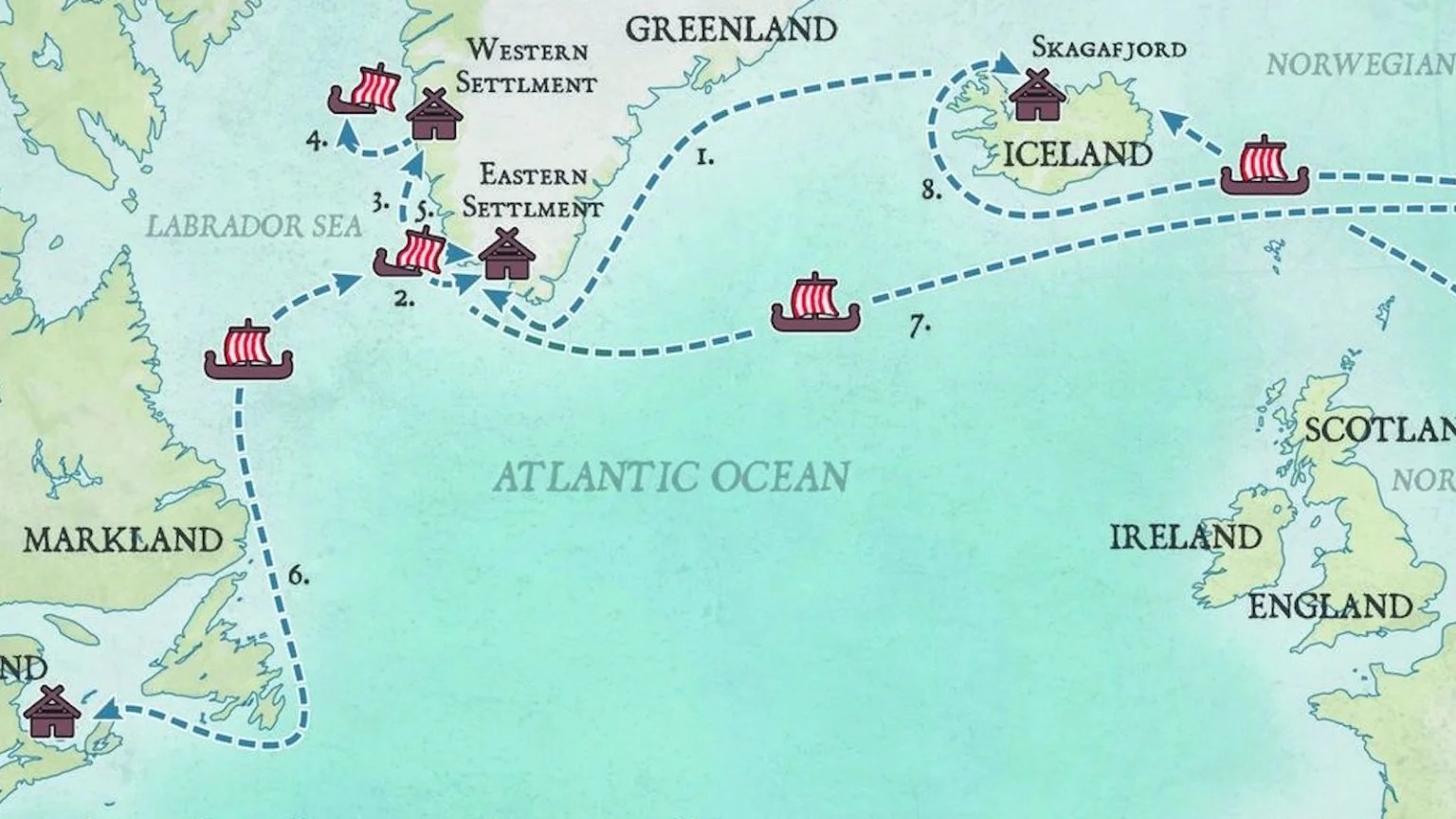
The amazing life of “Gudrid the Far-Traveled” has, Frank Jacobs argues, been unjustly overshadowed by her in-laws, Erik the Red and Leif Erikson…
She’s been called “the greatest female explorer of all time,” and the “best-traveled woman of the Middle Ages.” Just after the year 1000 AD, she gave birth to the first European baby in North America. And she concluded her global odyssey with a pilgrimage on foot to Rome. Yet few today can name this extraordinary Viking lady, even if they have heard of Erik the Red and Leif Erikson, her father- and brother-in-law…
An extraordinary story: “The Viking woman who sailed to America and walked to Rome,” from @VeryStrangeMaps in @bigthink.
* Dr. Seuss
###
As we tag along, we might recall that this date in 2014 was purportedly the date of the final battle in Ragnarök, a series of events (many natural disasters) culminating in a catastrophic battle and the end of the world-as-we-know-it: giants and demons approach from all points of the compass and attack the gods (Odin, Thor, Týr, Freyr, Heimdall, Loki, et al.), who meet them and face death like heroes. At the conflict’s end, the sun darkens, the stars vanish, and the earth sinks into the sea. (Happily, afterward, the earth rises again, the innocent Balder returns from the dead, and leads hosts of the just to a life in a hall roofed with gold.)
In the event, of course, the world did not end that day. The prediction had been promoted by the Jorvik Viking Centre in York, England, intended to draw attention to an event that the institution was to hold on that date. In an obvious lift from the 2012 Mayan Prophecy frenzy, the Centre attributed the claim to a “Viking Calendar,” though no such calendar is known to have existed. Authentic scholars were predictably (and understandably) irked, though as philologist Joseph Hopkins noted, the media response was an example of a broad revival of interest in the Viking Age and ancient Germanic topics.
(Historians believe that Gudrid did in fact exist and did make the journeys discussed above.)

“Sure, everything is ending, but not yet”*…

Front cover to the 15th edition of Caesar’s Column (1891)
Ignatius Donnelly migrated from Pennsylvania to Minnesota in 1858 in search of an agrarian dream (and a land promoter’s fortune). Frustrated on both of those fronts, he picked up his pen.
Twenty years of personal frustration turned his thoughts toward catastrophe. Reporting on the Dakota War of 1862, in which Sioux tribes struck back at encroaching settlers in western Minnesota, he had seemed to revel in the horrors of war. For a St Paul newspaper he described refugees from the town of New Ulm: “There were mothers there who wept over children slaughtered before their eyes, strong men . . . who had escaped into the grass with the death shrieks of parents, brothers, and sisters, ringing in their ears.”
Those death shrieks were just the start for a writer who came to specialize in cataclysms that could rend entire cities, ravage entire civilizations, or destroy entire continents. As his ambitions and plans repeatedly fell short — his agrarian golden age failed to materialize — he took up his pen to explore increasingly extreme visions of apocalypse. First came “factual” accounts of two very different prehistoric disasters — Atlantis (1882), followed by Ragnarok: The Age of Fire and Gravel (1883) — and then, seven years later, Caesar’s Column: A Story of the Twentieth Century (1890), a futuristic novel that major publishers rejected as dangerously revolutionary…
The remarkable story of a man who transmuted his personal disappointments into (very successful) epic apocalyptic fiction: “Master of Disaster, Ignatius Donnelly.”
* “Jules,” in Jennifer Egan’s A Visit from the Goon Squad
###
As we brace for the worst, we might recall that it was on this date in 1970 that Earl Kemp added 500 photos (“the sort of photographs the commission examined”) to the official report of the President’s Commission on Obscenity and Pornography and (re-)published it as The Illustrated Presidential Report of the Commission on Obscenity and Pornography.
The Commission’s work, which had been initiated under president Johnson, was rejected by President Nixon. Kemp (and his publisher William Hamling) were arrested for “pandering to prurience” and convicted of “conspiracy to mail obscene material.”

You must be logged in to post a comment.