Posts Tagged ‘inventions’
Sacrificing oneself for Progress…
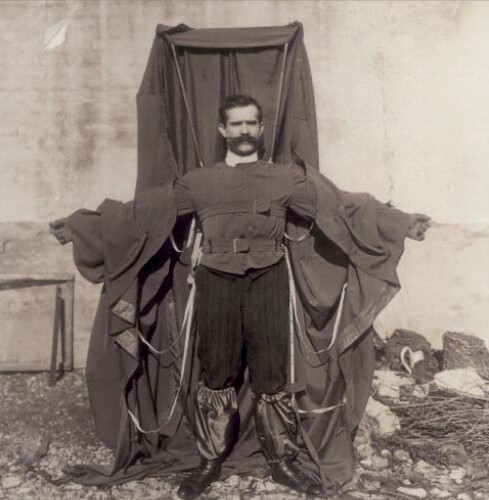 Fred “The Flying Tailor” Reichelt, who died in 1912 when he attempted to use this self-styled garment as a parachute in a jump off of the Eiffel Tower (source)
One is, of course, supposed to practice what one preaches, to eat one’s own dog food. But even as it’s only right to suggest that a physician “heal thyself,” it’s only fair to reference that healer’s Hippocratic Oath, and caution him/her “first, do no harm”…
Consider this List of Inventors Killed By Their Own Inventions.
As we head back to the drawing board, we might recall that it was on this date in 1950 that the daily comic strip Peanuts premiered in eight newspapers: The Washington Post, The Chicago Tribune, The Minneapolis Tribune, The Allentown Call-Chronicle, The Bethlehem Globe-Times, The Denver Post, The Seattle Times, and The Boston Globe. Its creator, Charles Schulz had developed the concept as a strip (L’il Folks) in his hometown paper, The St. Paul Pioneer Press, from 1947 to 1950. At its peak, Peanuts ran in over 2,600 newspapers, with a readership of 355 million in 75 countries, and was translated into 21 languages.

Visionary failures…
As one struggles to control “iPad lust,” one might take a moment to find perspective. Harry McCracken‘s terrific Technologizer is a great place to start.
In “Mr. Edison’s Kindle” Mr. McCracken observes that:
The brightest inventors on the planet keep coming up with ideas that never amount to much–even when they set out to solve real problems, and even when their brainchildren foreshadow later breakthroughs. And professional tech watchers have long proven themselves prone to getting irrationally exuberant about stuff that just isn’t ready for prime time.
… and then he regales one with fifteen great examples– from Edison’s “metal books” to “home teletypes,” inventions that spoke to real needs/desires (as events subsequently demonstrated), but that were at least a decade ahead of their times. For example:
 The Watch-Case Phonograph
As seen in: Popular Science, June 1936.
What it was: A bizarrely small phonograph built into a watch case. You wound it up like a mechanical timepiece, whereupon a “midget record” played music through a “diminutive horn.”
Flies in the ointment: It would have required the world to accept a new media format: midget records. (Their running time is unknown–wonder if you could fit an entire song onto one side?) Also, holding the player up to your ear would have gotten old fast.
When did the basic idea become practical? The introduction of the Sony Walkman in 1979 kicked off the era of pervasive, portable prerecorded music.
Modern counterpart: The iPod, of course.
Perhaps as a courtesy to Apple and the big news of the week, McCracken left the Newton off the list.
As we muse that timing is everything, we might recall that it was on this date in 1969 that the Beatles gave their last public performance– an impromptu concert from the roof top of Apple Studios in London. Neighbors complained about noise, and police broke up the concert… at which point John Lennon closed with: “I’d like to say thank you very much on behalf of the group and myself, and I hope we passed the audition.” Get Back!

You must be logged in to post a comment.