Posts Tagged ‘censorship’
The worst of the best…
“Mary and Holly” (Mary Kelly and Holly Hibner) are librarians at “a medium-sized public library in Michigan,” who have worked together for over ten years. They’ve developed a long suit in culling library collections– those of their own institution and those of libraries to which they consult.
In the course of that selective work, Mary and Holly face choices that are tough… and some that are not so tough. By way of celebrating that latter group– books that are “odd, outdated or maybe should be reconsidered under a current interpretation of collection policies”– they created Awful Library Books, showcasing such (currently-in-a-public-library-collection) gems as…
 Published in 1971: Usually the lingo and references are so dated, I can’t believe this would work for any school report for kids. Interestingly, this book also mentions nutmeg and a few cleaning fluids as sources of a nice high. So I guess this is more a “how to” type of book…
 “I can be obsolete”
Published in 1985: there are a lot of public libraries out there that own it. However, this is the first computer book we have posted that doesn’t seem to have an abundance of mullet hairstyles.
Browse the shelves at Awful Library Books.
As we head for the reference desk, we might spare a celebratory thought for an author who has had his own share of troubles with libraries (though, I’m quite confident, never with Mary and Holly): writer and aphorist Samuel Langhorne Clemens– Mark Twain– who was born on this date in 1835. The Adventures of Huckleberry Finn is consistently cited as a (if not indeed the) Great American Novel, at the same time that it is equally consistently the target of censors who would ban it from school and public libraries.

Got you covered…
With thanks to reader RS, a terrific post from STWALLSKULL, in honor of Banned Book Week (celebrated here), highlighting the covers of a number of comic books called out by Frederic Wertham in his inflamatory book Seduction of the Innocent, which led to the “Comics Code”– and the banning of several series.
There are some not-so-surprising entries, e.g.:

… and then, some real stoppers:

Read the entire post for the cautionary tale that it is.
As we rinse the ink from our fingers, we might spare a thought for Charles Darwin, who reached James Island (now better known as Santiago Island) in the Galapagos Archipelago on the H.M.S. Beagle on this date in 1835…
 James Island as it might have appeared to Darwin as he approached
![Reblog this post [with Zemanta]](https://i0.wp.com/img.zemanta.com/reblog_e.png?w=700)
51 areas, but not Area 51….

From the folks at Focus Research, a list of “51 Things You Aren’t Allowed to See on Google Maps“:
…for all of the places that Google Maps allows you to see, there are plenty of places that are off-limits. Whether it’s due to government restrictions, personal-privacy lawsuits or mistakes, Google Maps has slapped a “Prohibited” sign on the following 51 places.
1. The White House: Google Maps’ images of the White House show a digitally erased version of the roof in order to obscure the air-defense and security assets that are in place.
2. The U.S. Capitol: The U.S. Capitol has been fuzzy ever since Google Maps launched. Current versions of Google Maps and Google Earth show these sites uncensored, though with old pictures.
3. Dick Cheney’s [now Joe Biden’s] House: The Vice President’s digs at Number One Observatory Circle are obscured through pixelation in Google Earth and Google Maps at the behest of the U.S. government. However, high-resolution photos and aerial surveys of the property are readily available on other Web sites.
4. Soesterberg Air Base, in the Netherlands: This Dutch air-force base and former F-15 base for the U.S. Air Force during the Cold War can’t be seen via Google Maps.
5. PAVE PAWS in Cape Cod, Mass.: PAVE PAWS is the U.S. Air Force Space Command’s radar system for missile warning and space surveillance. There are two other installations besides the one in Cape Cod.
6. Shatt-Al-Arab Hotel in Basra, Iraq: This site was possibly censored after it was reported that terrorists who attacked the British at the hotel used aerial footage displayed by Google Earth to target their attacks.
7. Leeuwarden, Netherlands: This Dutch city is one of the main operating bases of the Royal Netherlands Air Force, part of NATO’s Joint Command Centre and one of three Joint Sub-Regional Commands of Allied Forces Northern Europe. Leeuwarden is also one of two regional headquarters of Allied Command Europe, headed by the Supreme Allied Commander Europe.
8. Reims Air Base in France: This lone building on Reims Air Base in France is blurred out.
9. Novi Sad: This military base in Serbia is off-limits.
10. Kamp van Zeist: Kamp van Zeist is a former U.S. Air Force base that was temporarily declared sovereign territory of the U.K. in 2000 in order to allow the Pan Am Flight 103 bombing trial to take place.
See the other 41 here… and note that, while (understandably) there’s no Street View photography available, Area 51 is on Google Maps.
As we unfold our maps, we might recall that it was on this date that, in 1952, the first UNIVAC, the world’s first commercially-produced electronic digital computer, was delivered to a customer– the Pentagon. UNIVAC, which stood for Universal Automatic Computer, was developed by J. Presper Eckert and John Mauchly, makers of ENIAC, the first general-purpose electronic digital computer (started by the U.S. Government in 1943 and finished in 1946) for use at Los Alamos and in other defense-related settings.
(In 1951,the U.S. Census Bureau “received” the first Univac, but it was operating at Remington Rand Labs; there was apprehension over disassembling and moving it… it finally did reach its home– then stayed in service long after it was obsoleted by advancing technology. Indeed, the Census Bureau used it until 1963– for twelve years.)
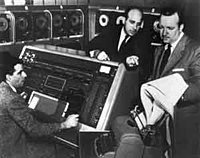 Eckert (center) demonstrating UNIVAC to Walter Cronkite (right)
You must be logged in to post a comment.