Posts Tagged ‘Boss Tweed’
“With new technologies promising endless conveniences also come new vulnerabilities”*…
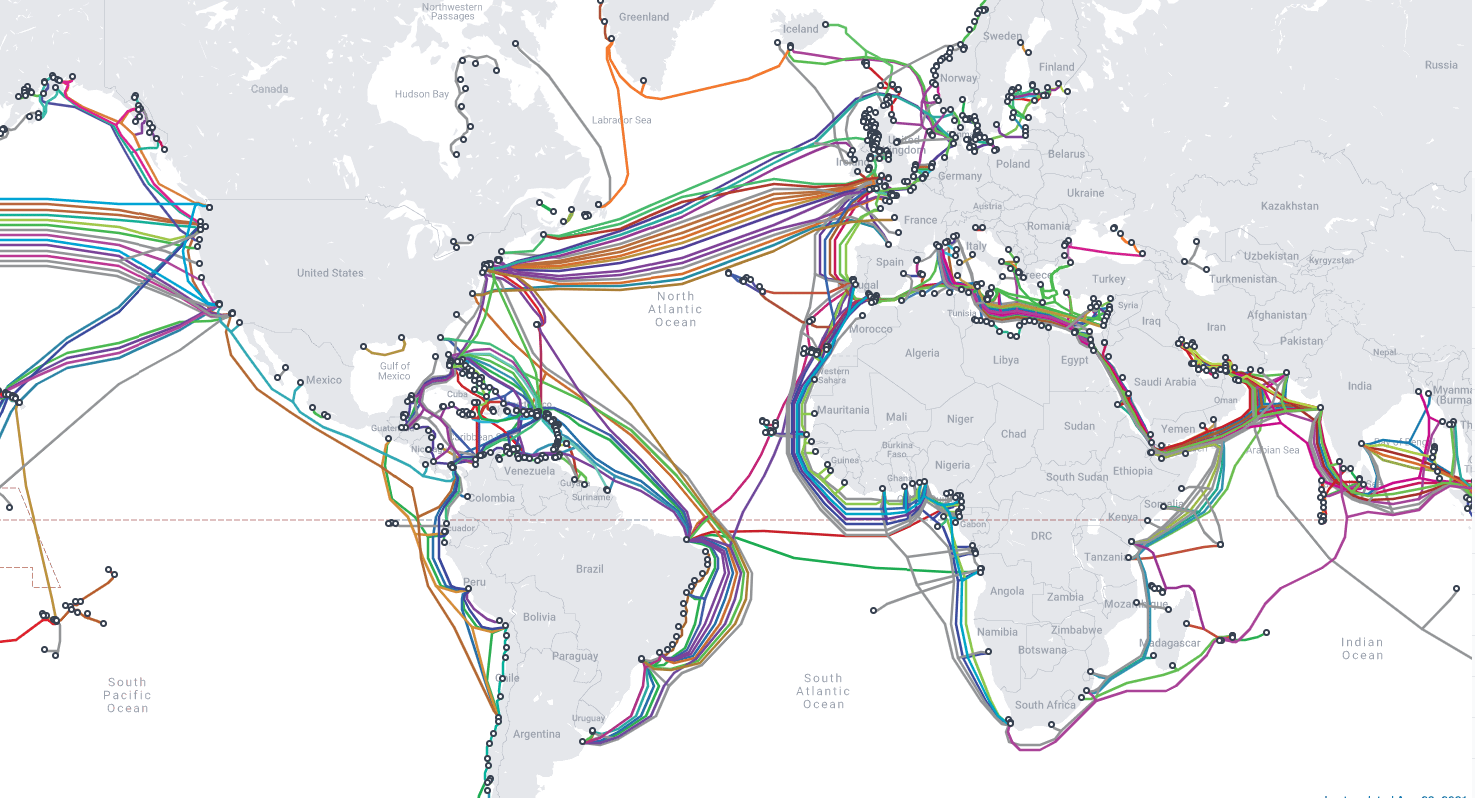
Many of us assume that most global communication is accomplished via satellite; in fact over 95 percent of international data and voice transfers are currently routed through the many fiber optic lines that crisscross the world’s seafloors. Earlier this year, (R)D took a look at the folks who lay, maintain, and repair these crucial cables. As noted there…
If, hypothetically, all these cables were to simultaneously break, modern civilization would cease to function. The financial system would immediately freeze. Currency trading would stop; stock exchanges would close. Banks and governments would be unable to move funds between countries because the Swift and US interbank systems both rely on submarine cables to settle over $10 trillion in transactions each day. In large swaths of the world, people would discover their credit cards no longer worked and ATMs would dispense no cash. As US Federal Reserve staff director Steve Malphrus said at a 2009 cable security conference, “When communications networks go down, the financial services sector does not grind to a halt. It snaps to a halt.”
Corporations would lose the ability to coordinate overseas manufacturing and logistics. Seemingly local institutions would be paralyzed as outsourced accounting, personnel, and customer service departments went dark. Governments, which rely on the same cables as everyone else for the vast majority of their communications, would be largely cut off from their overseas outposts and each other. Satellites would not be able to pick up even half a percent of the traffic. Contemplating the prospect of a mass cable cut to the UK, then-MP Rishi Sunak concluded, “Short of nuclear or biological warfare, it is difficult to think of a threat that could be more justifiably described as existential.”
Now, from TeleGeography, the interactive Submarine Cable Map, a free and regularly updated resource that allows one to locate any of the over 600 cable systems connecting the world. [Submarine Cable FAQ; even more here].
It’s fascinating to browse. Note, for example, the confluence of cables at the Northern Marianas and Guam…

Charting the web that connects the world: “Submarine Cable Map” from @TeleGeography.
Apposite: an argument that networks of connectivity are the battleground of the future: “From Mass to Distributed Weapons of Destruction.”
* Clara Shih
###
As we contemplate connectivity, we might note that John Mullaly was born on this date in 1835. Mullaly immigrated from Belfast to New York City, where he became a journalist. In 1854, he followed a story to Newfoundland, where he covered the laying of the first Transatlantic Telegraph Cable, in a series of articles, then in a book. Indeed, Mullaly became a booster of undersea cables, lecturing on them.
At the outbreak of the Civil War, Mullaly fell afoul of federal authorities by advocating against the draft. After the war, he left journalism for politics, joining the famously-corrupt Tweed Ring and Tammany Hall, where he became involved in the annexation of property in the Bronx (which had been unincorporated parts of Westchester County). Interestingly, Mullaly worked to create public parks in the Bronx, and founded the New York Park Association in 1881. His efforts culminated in the 1884 New Parks Act and the city’s 1888-90 purchase of lands (on many of which Mullaly and his Tammany cronies are believed to have profited) for Van Cortlandt, Claremont, Crotona, Bronx, St. Mary’s, and Pelham Bay Parks and the Mosholu, Pelham, and Crotona Parkways.
Mullaly Park in the south Bronx was named after him. But in 2021, after criticism and protests against Mullaly’s racist rhetoric during the murderous New York City draft riots (which Mullaly helped incite), the NYC Parks Department announced they would remove Mullaly’s name, instead honoring Reverend Wendell T Foster, the first Black elected in the Bronx (who as a long-standing New York City Council Member was a champion of the park and the neighborhood).

You must be logged in to post a comment.