Posts Tagged ‘Japan’
“In wrestling, nothing exists unless it exists totally”*…
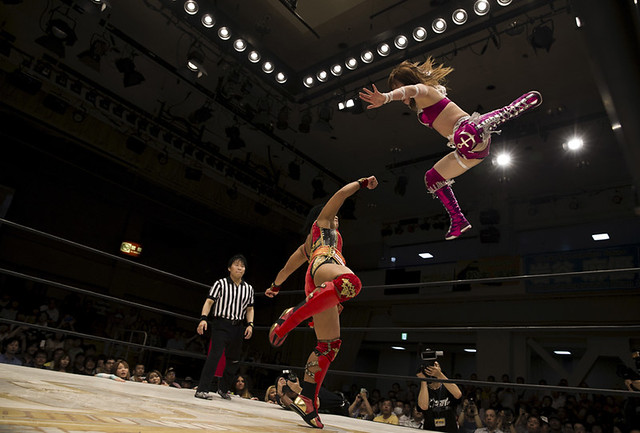
As Jesse Ventura once explained, professional wrestling is “ballet with violence.” Reuters photographer Thomas Peter spent time recently exploring the world of Japanese women’s pro wrestling. He reports that “professional women’s wrestling in Japan means body slams, sweat, and garish costumes. But Japanese rules on hierarchy also come into play, with a culture of deference to veteran fighters. The brutal reality of the ring is masked by a strong fantasy element that feeds its popularity with fans, most [but certainly not all] of them men.”

More (and several more photos) at “Professional Women’s Wrestling in Japan,” and at “Japan’s women wrestlers fight to win.”
* “In wrestling, nothing exists unless it exists totally, there is no symbol, no allusion, everything is given exhaustively; leaving nothing in shadow, the gesture severs every parasitical meaning and ceremonially presents the public with a pure and full signification, three dimensional, like Nature. Such emphasis is nothing but the popular and ancestral image of the perfect intelligibility of reality. What is enacted by wrestling, then, is an ideal intelligence of things, a euphoria of humanity, raised for a while out of the constitutive ambiguity of everyday situations and installed in a panoramic vision of a univocal Nature, in which signs finally correspond to causes without obstacle, without evasion, and without contradiction.”
– Roland Barthes, Mythologies
###
As we slam the mat, we might recall that it was on this date in 1994 that the first Induction Ceremony was held for the WWE Hall of Fame. The Hall had in fact been created the prior year; it’s inaugural inductee, (the recently-deceased) Andre the Giant. But that honor had simply been announced during an episode of Monday Night Raw. The class of 1994 included Arnold Skaaland, Bobo Brazil, Buddy Rogers, Chief Jay Strongbow, Freddie Blassie, Gorilla Monsoon, and James Dudley.

Bobo Brazil (Houston Harris), who is credited with breaking the racial barrier in professional wrestling
“There is only one difference between a long life and a good dinner: that, in the dinner, the sweets come last”*…

Japan’s government will no longer reward its centenarian citizens with a silver sake dish worth ¥8,000 ($64), saying the growing number of long-lived Japanese are putting a strain on the country’s budget.
The Japan Times reports that the government will find a more frugal gift in time for the country’s annual celebration of the elderly on Sept. 15. Last year, the government spent ¥260 million ($2 million) on the program, which provided dishes for more than 29,000 centenarians. Japan expects as many as 38,000 more people to celebrate their 100th birthday in 2018…
More on longevity– and the prospect of a “demographic time bomb“– at “Japan has so many 100-year-old citizens that it can’t afford to give them presents anymore.”
* Robert Louis Stevenson
###
As we settle in for the long haul, we might send birthday greetings to Abilene (Wrage) Spiehs; she was born on this date in 1898. When she died (on November 24, 2008), she was 110 years old– the oldest living Nebraskan at the time, and one of a select group of humans who lived to that age.

“There is no virtue whatsoever in creating clothing or accessories that are not practical”*…

Officially known as the “President’s emergency satchel,” the so-called nuclear “Football”—portable and hand-carried—is built around a sturdy aluminum frame, encased in black leather. A retired Football, emptied of its top-secret inner contents, is currently on display at the Smithsonian National Museum of American History. “We were looking for something that would demonstrate the incredible military power and responsibilities of the president, and we struck upon this iconic object,” says curator Harry Rubenstein.
Contrary to popular belief, the Football does not actually contain a big red button for launching a nuclear war. Its primary purpose is to confirm the president’s identity, and it allows him to communicate with the National Military Command Center in the Pentagon, which monitors worldwide nuclear threats and can order an instant response. The Football also provides the commander in chief with a simplified menu of nuclear strike options—allowing him to decide, for example, whether to destroy all of America’s enemies in one fell swoop or to limit himself to obliterating only Moscow or Pyongyang or Beijing.
Although its origins remain highly classified, the Football can be traced back to the 1962 Cuban missile crisis…
Read more about “the ultimate power accessory” in “The Real Story of the ‘Football’ That Follows the President Everywhere.”
* Giorgio Armani
###
As we play “button, button, who’s got the button,” we might spare a thought for Showa Tenno Hirohito, the 124th Japanese monarch in an imperial line dating back to 660 B.C.; he died on this date in 1989– after serving six decades as the emperor of Japan. He was the longest serving monarch in Japanese history.
Made Regent in 1921, Hirohito was enthroned as emperor in 1928, two years after the death of his father, Emperor Taisho. During his first two decades as emperor, Hirohito presided over one of the most turbulent eras in his nation’s history. From rapid military expansion beginning in 1931 to the crushing defeat of Japan in 1945, Hirohito stood above the Japanese people as an absolute monarch whose powers were sharply limited in practice. After U.S. atomic bombs destroyed Hiroshima and Nagasaki, it was he who argued for his country’s surrender, explaining to the Japanese people in his first-ever radio address that the “unendurable must be endured.” Under U.S. occupation and postwar reconstruction, Hirohito was formally stripped of his powers and forced to renounce his alleged divinity, but he remained his country’s official figurehead until his death. He was succeeded as emperor by his only son, Akihito.

“Emigration, forced or chosen, across national frontiers or from village to metropolis, is the quintessential experience of our time”*…

Nagoro is a remote village, tucked into the valleys of Shikoku Island in Japan. It was once hosted a thriving company, supporting hundreds of inhabitants. But its younger residents moved to bigger cities over the years in search of better jobs, abandoning the village permanently. The company is long gone, and Nagaro’s population is dwindling as the older villagers, left behind, continue to die.
Artist Ayano Tsukimi was one of those who left. She returned 11 years ago, to find her home much changed: the population had shrunk to under 40. So Tsukimi decided to repopulate the place herself – with handmade dolls. These dolls can be seen across the village on benches, in the street, outside her home, working in farms, and even lounging about the abandoned school compound. Over the last decade, she has sewn around 350 life-size dolls, each one representing a former villager…
Read more at “Japan’s Valley of the Dolls“; and see more in this video:
email readers, click here for video
* John Berger
###
As we channel Chucky, we might recall that it was on this date in 1932 that an attempted coup was launched in Japan by reactionary members of the Imperial Navy, in league with what was left of the ultra nationalist League of Blood. They were reacting to the Japanese government’s ratification of the London Naval Treaty, limiting the size of the Imperial Japanese Navy. In what has become known as “the May 15 Incident,” eleven young naval officers assassinated Prime Minister Inukai Tsuyoshi. The rebellion was put down, and the eleven conspirators quickly arrested.
In that trial that followed, strong popular support for the rebels– sympathizers sent the court a petition for leniency signed, in blood, by 350,000– led to light sentences, which in turn led to further erosion of rule of law and democratic process, laying the base for the explosive expansion of nationalism and militarism in Japan that tipped the nation toward World War II.

Osaka Mainichi Shimbun describing the May 15 Incident
Stack ’em high…

While most of us in the U.S. are finding it harder and harder to locate a bookstore, literary retail continues relatively strong in Japan. Indeed, in a market where a flood of publications– novels, non-fiction, and lots (and lots) of manga– make it hard for a book to stand out, retailers are using creative displays to highlight their featured titles.
See more gravity-defying examples at “The avant-garde art of book stacking in stores of Japan.”
###
As we remove our choices oh-so-carefully, we might send free-thinking birthday greetings to Taiji Yamaga; he was born on this date in 1892. A translator, publisher, and pacifist activist, Yamaga led resistance to Japanese involvement in World War I; then, when Japan invaded China, decamped to Manila, where he wrote and edited an anti-war newspaper (and created the first Tagalog-Japanese dictionary). On his return to Japan after the war, he helped found the Japanese Anarchist Federation.
A champion both of Lao Tzu and Esperanto, he translated the writings of the former into the latter.

Taiji Yamaga and his wife Mika
You must be logged in to post a comment.