Posts Tagged ‘FTC’
“The roots of the word ‘compete’ are the Latin con petire, which meant ‘to seek together'”*…

Peter Thiel would have us believe that “competition is for losers.” The FTC begs to differ. Earlier this month, it introduced a proposed rule that would eliminate employee noncompete agreements. Scott Galloway explains why this is a very good plan…
… Yesterday’s iconoclasts pull the ladder up behind them the moment they become today’s icons. We’re in general agreement that “anti-competitive” behavior is bad, and have laws against it. Yet companies have been able to convince regulators to look the other way on an increasingly popular weapon of mass entrenchment. They’re passing out OxyContin during an AA meeting. The Oxy? Noncompete agreements…
Noncompete clauses are what firms use to sequester your human capital from competitors. When a new employee signs a noncompete with, say, Johnson & Johnson, they agree that when their employment ends, they won’t work at another pharmaceutical company for a designated period — usually one to two years. If you’re familiar with noncompetes, you likely associate them with technology jobs, where employers want to protect valuable intellectual property. And that’s the defense most often offered for the restrictions. BTW, the argument is bullshit … a confidentiality agreement does the trick.
The irony of noncompetes is they only serve to dampen growth. One of the few places where they’re banned is also home to the world’s most innovative tech economy: California. Job-hopping and seeding new acorns have been part of Silicon Valley since the beginning. In 1994 a Berkeley economist theorized that California’s ban on noncompetes was one of the main reasons Silicon Valley existed at all, and in 2005, economists at the Federal Reserve put forward statistical evidence supporting the theory. Apple, Disney, Google, Intel, Meta, Netflix, Oracle, and Tesla were able to succeed without limiting the options of their employees.
Yet outside California, corporate boardrooms love noncompetes. Historically they were attached only to high-skilled, high-paying jobs. Now they’re becoming ubiquitous across different industries at all levels. Fast-food workers are being forced to sign noncompetes, as are hairstylists and security guards. Roughly a third of minimum wage jobs in America now require such agreements. If forcing noncompetes on America’s lowest-paid workers sounds like indentured servitude, trust your instincts.
Employers claim noncompetes give them the assurance to pay for training and other investments in their employees. There is some evidence that noncompetes are associated with more worker training. But there’s a catch: They also decrease wages. The good news is we’ll train you to operate the fryer, the bad news is we won’t pay you a living wage to do it — and you can’t take a better job across the street.
The FTC estimates that noncompetes reduce employment opportunities for 30 million people and suppress wages by $300 billion per year. That’s far more than the total value of property stolen outright every year. Multiple studies also show that noncompetes reduce entrepreneurship and business formation. Which makes sense — it’s difficult to start a business when talent pools are not accessible or allocated to their best use. Downstream, the lack of competition leads to entrenchment, which eventually results in higher prices for consumers — as one study found has occurred in health care. Everybody loses. Except, of course, the incumbent’s shareholders…
It’s worth remembering the insight of W. Edwards Deming, one of the architects of Japan’s rise to industrial leadership after World War II: “In 1945, the world was in a shambles. American companies had no competition. So nobody really thought much about quality. Why should they? The world bought everything America produced. It was a prescription for disaster.”
The case against noncompete agreements: “Compete,” from @profgalloway.
See also: “Noncompete Agreements Reduce Worker Pay — and Overall Economic Activity” (source of the image above).
* Mihaly Csikszentmihalyi
###
As we remove the shackles, we might recall that it was on this date in 1915 that Ralph Chaplin, a Wobblie (a member of the Industrial Workers of the World) finished his poem “Solidarity Forever“– which, sung to the tune of “John Brown’s Body”/The Battle Hymn of the Republic,” has become a labor movement anthem.

“If You Can’t Fix It, You Don’t Own It”*…
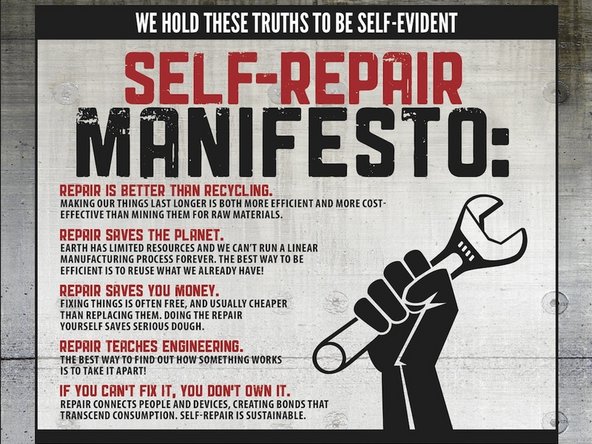
A just-issued report by the US Federal Trade Commission confirms that anti-repair actions by large companies are hurting small businesses, undermining your ownership rights, and hurting the planet. Of course, these are the very problems that we’ve been fighting for the past fifteen years—but it’s validating to see US government confirmation of the market imbalance.
The unanimous report, nearly two years in the making, follows public hearings and testimony from the FTC’s “Nixing the Fix” workshop in July 2019, and a demand from Congress in 2020 to report back. iFixit and other repair advocates told the Commission then how manufacturers design products that frustrate repair and force owners to use the manufacturers’ branded repair services, hurting consumers and stifling competition. Manufacturers claimed the market was working fine, and that opening up repair access would undermine the safety and security of their products. Today’s report is a rebuke to their arguments.
The FTC’s long-awaited report provides a thorough analysis of broad market failures, and recommendations for government action to address those failures. Some major findings included in the report:
– Warranties are being routinely voided, in violation of the Magnuson Moss Warranty Act. “The Commission takes these allegations seriously and will continue to address illegal practices in the marketplace.”
– “[T]he burden of repair restrictions may fall more heavily on communities of color and lower-income communities.”
– “The pandemic has exacerbated the effects of repair restrictions on consumers.”
…
The report summarizes the problems that consumers are facing from a variety of monopoly strategies. “Many manufacturers restrict independent repair and repair by consumers through:
– Product designs that complicate or prevent repair;
– Unavailability of parts and repair information;
– Designs that make independent repairs less safe;
– Policies or statements that steer consumers to manufacturer repair networks;
– Application of patent rights and enforcement of trademarks;
– Disparagement of non-OEM parts and independent repair;
– Software locks and firmware updates; or
– End User License Agreements.”
…
A rebuke of Apple, John Deere, and other manufacturers whose practices frustrate repair by “owners”: “FTC Report Finds Manufacturers’ Repair Restrictions Unwarranted.” Via @kwiens and @stewartbrand
###
As we resist rentiers, we might recall that it was on this date in 1893 that the U.S. Supreme court unanimously ruled that a tomato is a vegetable. In reaching their decision in Nix v. Hedden, a dispute over the appropriate duties to be levied pursuant to the Tarriff Act of 1883, the justices found that the “ordinary” understanding of a tomato as a vegetable should take precedence over the scientific fact that it is a fruit.

You must be logged in to post a comment.