Archive for November 2008
Some things change; some things stay the same…

It was 71 years ago this month that Alan Turing published the paper “On Computable Numbers with an Application to the Entscheidungsproblem” (an extension of Godel’s thinking in answer to a challenge from Hilbert), that laid the intellectual foundation for computing by positing a “Universal [aka Turing] Machine.”
Turing went on to distinguish himself as a cryptographer at Bletchley Park, a key member of the team that broke the German Enigma code, and surely shortened– indeed, may have changed the course of– World War II.
But then, in 1952, Turing was prosecuted for his homosexuality, still a crime in those days. Convicted, he took a course of hormone therapy, designed to “cure” him, instead of a jail term. Though Turing’s loyalty was never questioned, homosexuals were considered security risks; Turing’s clearance was revoked. In 1954, disheartened, he committed suicide.
In the years since then, the world has come better to understand the full scope and depth of Turing’s extraordinary contributions– to knowledge, and to peace and freedom. And in his native England, as in much of the West, society has come to understand diversity of sexual preference as– at the least– worthy of respect and tolerance.
So in the saddest of ways, it’s ironic that this same month is a month in which several of the United States passed propositions that would reinstate the prejudices that brought Turing low, and would deny– in some cases, roll back– civil liberties, as they were denied to Turing.
As we watch good deeds punished, we might whisper Joyeux Anniversaire to Francois-Marie Arouet, better known as Voltaire, who was born on this date in 1694, and who might well have been channelling today’s missive when he asked (in “Tolerance”) “What is tolerance? It is the consequence of humanity. We are all formed of frailty and error; let us pardon reciprocally each other’s folly — that is the first law of nature”… and when he wrote:
All men are equal; it is not their birth,
But virtue itself that makes the difference.
– Eriphile, Act 2, Scene 1

Wee, wee, wee…
The art of the very tiny: Molecular Expressions— “going where no microscope has gone before by offering one of the Web’s largest collections of color photographs taken through an optical microscope (commonly referred to as ‘photo-micro-graphs’)”
The photo gallery contains microscopic views of everything from biologicals to pharmaceuticals to mechanics… including familiar foods; e.g.,

As we meditate on fractal propriety, we might wish a reverent Happy Birthday to Susanna Wesley, “The Mother of Methodism”; she was born on this date in 1669. The youngest of 25 children born to a dissenting Anglican priest and his wife, Susanna married poet Samuel Wesley, with whom she had 19 children herself– two of whom were fathers of the Methodist Movement, John and Charles Wesley.
…although she never preached a sermon or published a book or founded a church, is known as the Mother of Methodism. Why? Because two of her sons, John Wesley and Charles Wesley, as children consciously or unconsciously will, applied the example and teachings and circumstances of their home life.
– Pellowe

What’s old is new again…
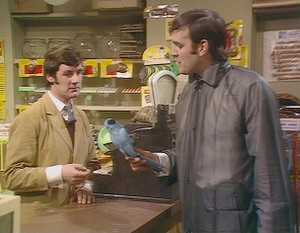
Readers may recall earlier missives (c.f. here and here) on Philogelos, the ancient Greek joke book. (See this New Yorker piece for an account of Philogelos in the context of “joke history.”)
Lest we think that’s there’s anything new under the sun, Slashdot, citing a (London) Telegraph story, reports that:
Monty Python’s [1969] “Dead Parrot sketch,” which featured John Cleese ‚ is some 1,600 years old. A classic scholar has proved the point, by unearthing a Greek version of the world-famous piece. A comedy duo called Hierocles and Philagrius told the original version, only rather than a parrot they used a slave. It concerns a man who complains to his friend that he was sold a slave who dies in his service. His companion replies: “When he was with me, he never did any such thing!” The joke was discovered in a collection of 265 jokes called Philogelos: The Laugh Addict, which dates from the fourth century AD.
The full text of the classic Monty Python routine is here; the video, here.
As we tussle with our titters, we might send birthday wishes to Alan Young, who was for 6 seasons (144 episodes) the conversational partner of that most eloquent equine, Mr. Ed. (Less well known is that Young also voiced Scrooge McDuck for several years…) Young was born on this date in 1919.
 Alan Young, with co-star Mr. Ed (Young on right)
Still basking in post-election glow, reader PL sends along this terrific spread from ArtDaily…
The Annals of Etymology, Volume 4…
As readers probably know, the basic unit of measurement of information storage/computer memory is the “byte,” which is usually– but interestingly, not always– 8 bits (that’s to say, 8 binary digits, each with a value of 1 or 0). Less well known is the name of a half-byte: a “nibble”… or, as it’s sometimes (understandably) spelled, a “nybble.”
As we save this update, we might wish a representatively-sampled and carefully-counted Happy Birthday to George Gallup, who was born on this date in 1901. Gallup, who had been a university professor, and an advertising research pioneer, founded the American Institute of Public Opinion in 1935. The following year, during the Roosevelt-Landon campaign, Gallup revolutionized opinion polling. In 1916, Literary Digest had embarked on a national survey (partly as a circulation-raising exercise) and correctly predicted Woodrow Wilson’s election as president. Mailing out millions of postcards and simply counting the returns, the Digest correctly called the following four presidential elections.
In 1936, its 2.3 million “voters” constituted a huge sample; however they were mostly affluent Americans– subscribers– who tended to have Republican sympathies. A week before the election, Literary Digest reported that Alf Landon was far more popular than Franklin D. Roosevelt. At the same time, Gallup conducted a much smaller survey, in which he polled a demographically representative sample– and correctly predicted Roosevelt’s landslide victory. Literary Digest soon went bust, while professional “scientific” polling started, led by Gallup and Elmo Roper (who also surfaced with the 1936 election) to take off.

George Gallup (source)
Holiday shopping season is already open…
… and this year, despite the slings and arrows of an outrageous economy, it’s possible still to give creatively…
By way of example, Mental Floss has a terrific collection of dolls that are sure to surprise, delight– even educate. Consider, for example, Lady Jane Grey and Marie Antoinette:

If, as we make our lists, we are considering firearms for the tykes in our lives, we might recall that it was on this date in 1871 that The National Rifle Association was chartered (in New York). Its first president was Ambrose Burnside, a former governor (Rhode Island), Senator, and Civil War general; it has of course been politically active ever since.
You must be logged in to post a comment.