Archive for May 2009
Oh, THERE you are…

From i09:
Astrophysicist Ragbir Bhathal works with SETI [Search for Extraterrestrial Intelligence] to scan the skies for possible communications from extraterrestrial intelligences. Unlike most SETI facilities, which look for radio signals, Bhathal’s looks for laser pulses. And now he’s found one.
Several years ago Bhathal, a researcher at the University of Western Sydney, suggested that a likely form of extraterrestrial communication would be laser bursts. He set up a facility at his lab which sweeps a nearby volume of space, within about 100 light years, for laser bursts that come in a regular pattern. Any kind of communication would likely be distinguished from background noise by coming in repeated or non-random patterns.
And a few months ago, Bhathal found the kind of regular pattern he’s been looking for. He’s been analyzing it and seeking a repeat pattern in the same area of space ever since. Though he’s cautious about claiming it as a genuine extraterrestrial signal, his discovery has been making local news. Read all about it in The Australian.
As we rethink our place in the cosmos, we might that it was on this date in 1953 that the first 3-D science fiction film, It Came from Outer Space, opened– the anniversary of Irish novelist Bram Stoker’s 1897 introduction of “the thirsty Count,” Dracula. (Stoker’s buddy, the great Victorian actor Sir Henry Irving– with his dramatic presence, gentlemanly mannerisms and affinity for playing villain roles– was the model for the Count. Irving, however, never agreed to play the part on stage.)

Hark!…

The British Library conjures images of rows and rows of books– and indeed, as a copyright depository, it’s home to acres and acres of them. But its curatorial role extends beyond print to audio. And its creativity in applying new technology to its collections (c.f., here and here, e.g.) is making it’s recordings available in new ways too.
The BL’s Archival Sound Recording Project has already processed over 21,000 recordings– everything from spoken word performances of works in the print collection (often by the authors– c.f., here) to the sounds of amphibians (mostly frogs and toads) around the world (here); and it is experimenting with mash-ups, laying the recordings on maps, e.g., the music of India (here).
But perhaps the most immediately useful (or, at least, amusing) is this map of accents and dialects from all over Great Britain, “illustrated” by over 700 recordings.
As we offer thanks to the librarians among us, we might recall that it was on this date in 1911 that later-to-be Nobel Laureate Thomas Mann visited the Lido in Venice and crystallized the idea for his haunting novella Death In Venice. While Mann was adamant throughout his life that the protagonist, Aschenbach, was in no way autobiographical, his posthumously-available diaries suggest that Mann was in fact infatuated at the shore with a young Polish boy (the 11 year old Wladyslaw Moes ) who became the model for Tadzio.

Just when you were beginning to feel a little safer…

The Army News Service reports that, even as Microsoft itself is quietly declaring defeat on widely-reviled Vista and trying to shift attention to the can’t-be-soon-enough release of Windows 7, the U.S. Army is moving all of it’s PCs to Vista…
Army migrating computers to Vista
May 20, 2009
By Gary Sheftick and Delawese FultonWASHINGTON (Army News Service, May 20, 2009) — The Army is migrating
all of its Windows-based computers to Microsoft’s Vista operating
system to bolster Internet security and standardize its information
systems.The systems change, which includes swapping Office 2003 for Office
2007, is set to be completed by Dec. 31.
The official release suggests that
First-time Vista users will discover added support for data
encryption, a new Windows Explorer, upgraded icons and navigation
structure…
… or not.
In any case, read the full piece here.
As we console ourselves that Trojan Horses have had a place in warfare since the time of Homer, we might recall that it was on this date in 1844 that Samuel F. B. Morse taped out the first message sent over the (first) “telegraph” line: “What hath God wrought?” Morse sent the famous message from the B&O’s Mount Clare Station in Baltimore to the Capitol Building. (The words were chosen by Annie Ellsworth, the daughter of the U.S. Patent Commissioner, from Numbers 23:23.)

A taxonomy of turns…
From our friends at The Infrastructurist, “A Field Guide to Freeway Interchanges” (Part Two, here)…
Never again need we be confused by the difference between a “Spooey” (Single Point Urban Interchange, or “SPUI”):

…and a “Clovermill” (partial cloverleaf with turbine-style flyover [or, elevated] ramps):

Collect all 31 here (and here).
As we activate our turn indicators, we might recall with gratitude that it was on this date in 1969 that the BBC ordered the first 13 episodes of a new comedy sketch show improbably titled Monty Python’s Flying Circus (which premiered on October 5 of that year).
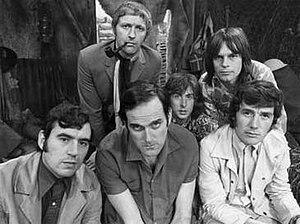
Hours of amusement on the MPFC YouTube channel, here…
Tweet, tweet…
Twitter, that font of 140-character updates, assertions, musings, and forwarded links, has its fans (“revolutionizing journalism”) and it’s detractors (“who cares?”)… but even if one stipulates to Twitter’s ultimate place in the technosphere, one observes that getting there is a heuristic process…
Consider, for example, the postings collected at OverSharers, e.g,

and at TweetingTooHard, e.g.,
 (Yes, it’s that John Mayer…)
With thanks to reader PR (and to his brother, WR) for the tip, your correspondent notes that (Roughly) Daily can be followed on Twitter here :)
As we fiddle on the frontier, we might recall that it was on this date in 1843 that a thousand pioneers left Elm Grove (near Independence), Missouri in the first major wagon train on the Oregon Trail, a massive caravan, 1,000 settlers and 1,000 head of cattle. Known as the “Great Emigration,” the expedition came two years after the first modest party of settlers made the long, overland journey to Oregon. The giant wagon train finally arrived in October, completing the 2,000-mile journey from Missouri in five months.
In the next year, four more wagon trains made the journey, and in 1845 more than 3,000 emigrants used the Oregon Trail. But with the advent of the railroads, travel along the trail gradually declined; and the route was finally abandoned in the 1870s.

You must be logged in to post a comment.